

Communication is at the heart of every senior living community.
Every day, staff members coordinate care, answer questions from family members, respond to emergency calls, and support residents across multiple departments. The quality of that communication directly affects patient care, safety, staff efficiency, and the overall resident experience.
As many organizations move away from aging infrastructure, on-premises equipment, and traditional phone systems, now is the ideal time to evaluate whether your current phone system truly supports your community’s needs.
The right technology can help organizations address staffing shortages, control rising costs, and improve communication across departments without forcing residents or employees to give up the tools they already know how to use.
A modern senior living phone system is about much more than replacing a typical landline. It's an investment in better service, greater flexibility, and long-term operational efficiency.
Why Communication Is Critical in Senior Living Operations
Today's senior living communities rely on constant communication between caregivers, administrators, maintenance teams, dining staff, admissions, and outside care providers.
Staff members also need to be more tech savvy than they were in the past. They may communicate through desk phones, mobile devices, paging systems, nurse call systems, text messages, and video meetings, sometimes during the same shift.
When communication breaks down, delays follow.
Missed calls, inefficient call routing, disconnected systems, and difficulty reaching employees who are away from their desks can quickly become major challenges for staff and residents alike.
The right business phone system helps eliminate those barriers by making communication faster, simpler, and more reliable. Whether employees are making calls from an office phone, using a desktop app, carrying a wireless handset, or answering through a mobile VoIP phone, everyone can stay connected through one coordinated platform.
What Should a Senior Living Phone System Include?
The best phone system combines reliability with tools that simplify everyday communication and support the specific needs of a senior living environment.
Important features can include:
- Intelligent call routing that directs callers to the correct department
- PBX department extensions for dining, maintenance, nursing, admissions, and the front desk
- Easy ways to transfer calls between departments and employees
- Voicemail transcription so messages can be reviewed quickly
- Call recording for training and quality assurance
- Professional caller ID
- Business texting with unlimited texting options
- Unlimited calls throughout the United States
- Mobile applications for employees using a cell phone
- Secure video conferencing and video meetings
- Built-in team chat and other team collaboration features
- Call summaries powered by artificial intelligence
- Reporting with business analytics and advanced analytics tools
- Mass notification and overhead paging capabilities
- Emergency call integration with panic buttons, pull cords, and pendants
- Backup power and network redundancy
These advanced features help staff spend less time managing communication and more time supporting residents.
Supporting the Resident Experience
The resident experience should be a central part of any phone system decision.
Many residents have used the same type of home phone for decades. They may be comfortable with a familiar analog phone that has large buttons, a loud ringer, speed-dial settings, or other accessibility features.
Moving into a senior living community already involves significant change. Residents shouldn’t necessarily have to learn an unfamiliar phone or complicated mobile application just to call family members.
A flexible senior living phone system may allow residents to bring a compatible analog phone they already know how to use. Communities may also be able to provide simple analog phones that preserve the familiar dialing experience residents expect.
Residents can continue making and receiving calls with a traditional handset while the community manages those calls through a more modern communications platform behind the scenes.
This approach can provide residents with:
- Familiar phones and dialing experiences
- Personal phone numbers
- Reliable access to family members and friends
- Large-button and high-contrast phone options
- Adjustable volume and hearing-aid-compatible devices
- Speed dialing for frequently called contacts
- Simple voicemail or answering machine functions
- Direct access to the front desk or other community departments
The goal isn’t to add technology for technology’s sake. It’s to improve communication while keeping the resident experience comfortable and accessible.
The Role of a Hybrid VoIP-Analog Phone System
Many senior living organizations aren’t moving directly from basic copper landlines to a completely cloud-based environment.
Instead, they may be replacing an existing on-premises system or an older business communications platform from a provider such as Mitel, Avaya, Cisco, or NEC. These systems may still support hundreds of extensions, analog resident phones, paging equipment, fax machines, door entry systems, and other connected devices.
Replacing every phone and endpoint at once may be expensive, disruptive, and unnecessary.
A hybrid VoIP-analog phone system offers another option.
This type of system blends traditional analog equipment with internet-based calling. Staff can access modern VoIP service and collaboration tools while residents continue using compatible analog phones.
A hybrid approach may also allow a community to modernize in phases. Administrative departments can receive updated IP phones and mobile capabilities first, while resident rooms and certain analog devices remain connected through gateways or adapters.
Over time, the organization can update additional devices based on its budget, operational priorities, and technology roadmap.
This helps communities preserve useful equipment while still gaining modern features, centralized administration, improved call routing, and greater flexibility.
Why Traditional Phone Systems Fall Short
Many facilities still operate with traditional phone systems that weren't designed for today's communication needs.
Older systems often limit flexibility, require expensive hardware upgrades, and make it difficult for mobile employees to stay connected. Replacement parts may also become more difficult to find as certain phone models and platforms approach the end of their supported life.
These systems often lack the reporting, mobile integration, business texting, and collaboration features organizations now expect.
Modern solutions built on Internet Protocol technology provide significantly more flexibility than a typical landline while delivering greater reliability and scalability.
Instead of being tied to a single physical device, employees can answer calls using desk phones, computers, or their mobile devices while keeping the same phone number.
Many organizations can even keep their existing number, making the transition nearly seamless for residents and outside contacts.
Emergency Call Integration and Mobile Staff Communication
Emergency communication is one of the most important considerations for any senior living community.
Panic buttons, pull cords, and pendants should route alerts quickly and consistently to the appropriate staff members. Depending on the community’s systems and workflows, alerts may need to appear on desk phones, mobile devices, wireless handsets, or multiple endpoints at once.
Mobile integration is particularly important because caregivers and maintenance employees rarely spend their entire shifts sitting at desks.
Many communities use DECT phones or durable wireless handsets from manufacturers such as Spectralink or Poly. Others use smartphones with an app connected to the main phone system.
Both approaches can help employees:
- Receive calls throughout the campus
- Respond to emergency alerts
- Transfer callers without returning to a desk
- Communicate between buildings
- Access voicemail and messages
- Remain reachable while assisting residents
The right setup depends on the size of the property, building materials, network coverage, staff workflows, and emergency response procedures.
Redundancy and Backup Power
Senior living phone systems are often connected to life-safety-adjacent workflows. Reliability should therefore be evaluated as part of the complete system design, not treated as an optional feature.
Communities should ask providers about:
- Backup battery options
- Generator failover
- Secondary internet connections
- Automatic call forwarding during an outage
- Local survivability
- Network redundancy
- Emergency dialing procedures
- Monitoring and support
- Disaster recovery planning
A cloud phone system still depends on a properly designed network, reliable internet connectivity, and an appropriate backup strategy.
The right provider should evaluate these requirements before recommending a solution.
Choosing the Right VoIP Provider
As you'd expect, not all VoIP providers offer the same level of expertise, implementation support, or understanding of senior living environments.
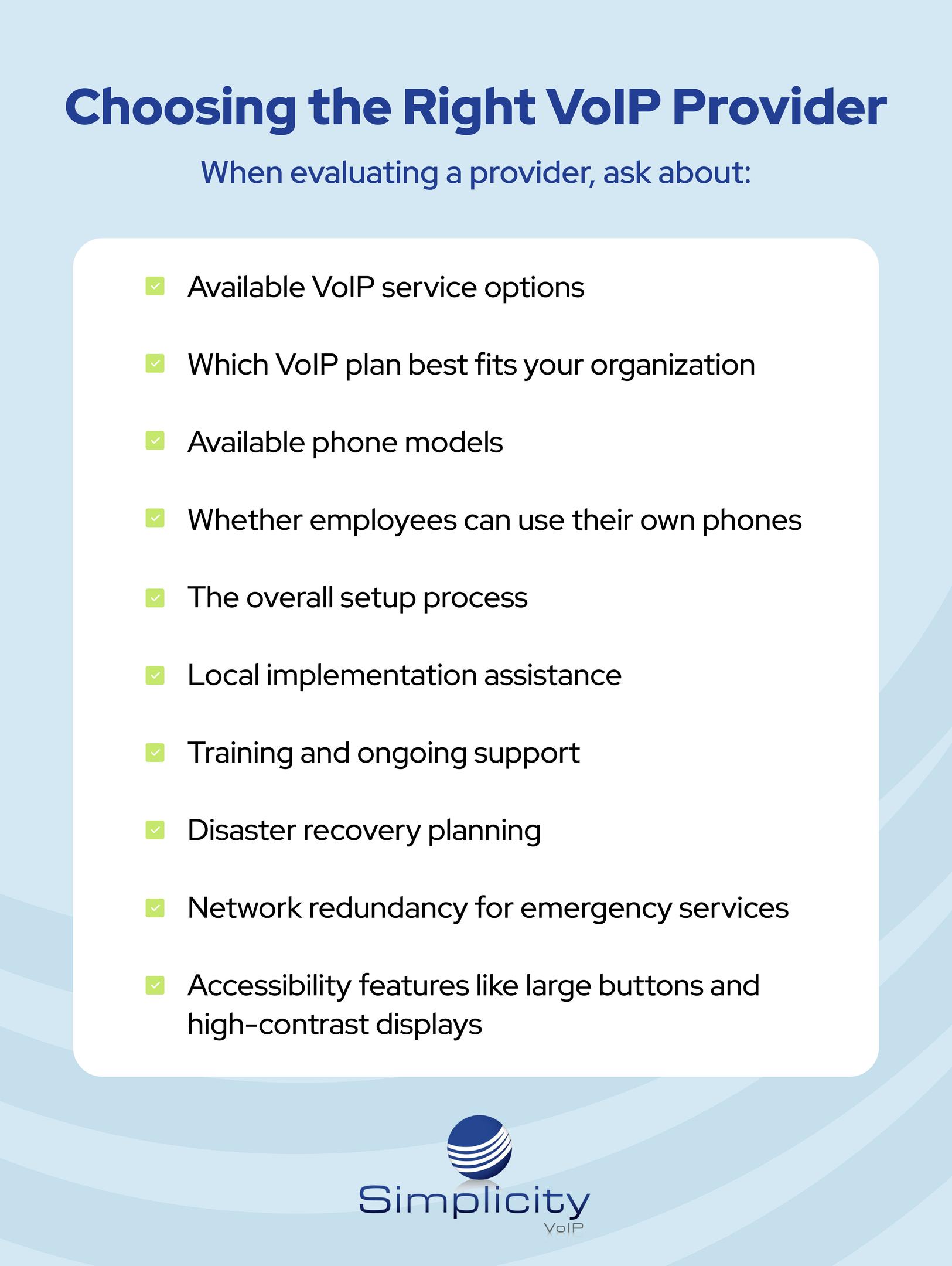
When evaluating a provider, ask about:
- Available VoIP service options
- Hybrid VoIP and analog capabilities
- Which VoIP plan best fits your organization
- Available phone models
- Support for resident analog phones
- Compatibility with existing paging and nurse call systems
- Whether employees can use their own phones
- Mobile and DECT handset options
- The overall setup process
- Local implementation assistance
- Employee and administrator training
- Ongoing support
- Disaster recovery planning
- Network redundancy for emergency services
- Accessibility features such as large buttons and high-contrast displays
The right partner won’t simply install new equipment. They’ll evaluate your current environment, identify your communication goals, and recommend the right phone system based on your organization’s needs and desired growth.
They should also help determine which existing phones and devices can remain in place, which equipment should be replaced, and how the migration can occur without unnecessary disruption.
Features That Improve Operations
Many of today's phone systems include integrations with customer relationship management (CRM) software, allowing admissions or administrative teams to see important caller information before answering.
Sales and admissions staff can benefit from CRM integrations, while the sales team gains visibility into communication activity without manually tracking conversations.
Other valuable capabilities include:
- Advanced analytics that identify trends
- Automated call summaries
- Intelligent call routing
- Artificial intelligence-powered recommendations
- Flexible permissions for multiple users
- Support for unlimited users, depending on the solution
- Collaboration tools for employees working across multiple buildings
The best solution depends on your operational goals, compliance needs, desired integrations, existing infrastructure, and long-term support requirements.
Finding the Best Value

Choosing a communications platform isn't just about finding the lowest monthly bill.
Instead, focus on cost savings over time by selecting a solution that reduces administrative work, improves communication, and supports growth.
The most cost-effective option often isn't the cheapest. It's the one that provides the right features, dependable support, and room to scale as your organization grows.
Many providers offer affordable plans, but evaluating the overall value, not just the monthly price, is the best way to determine the best value for your organization. Not to mention staying compliant. HIPAA-compliant VoIP options protect resident data and communication.
Frequently Asked Questions
What is a senior living phone system?
A senior living phone system is a communications platform designed to support the unique needs of assisted living communities, independent living facilities, memory care centers, and other senior care organizations. It helps improve communication between staff, residents, families, and outside providers.
What is a hybrid VoIP-analog phone system?
A hybrid VoIP-analog phone system combines internet-based calling with support for traditional analog phones and devices.
It can allow staff to use modern VoIP features while residents continue using familiar analog phones. It may also help communities retain compatible paging equipment, fax machines, emergency devices, and other existing technology.
Can residents bring their own analog phones?
In many cases, yes. A properly designed hybrid system may support compatible analog phones through analog ports, gateways, or adapters.
The provider should evaluate the phone, wiring, platform, and desired features before confirming compatibility.
Can residents keep the features they’re accustomed to?
Many familiar features can be preserved, including personal phone numbers, speed dialing, voicemail, adjustable volume, caller ID, and simple handset-based calling.
Available features will depend on the phone model and how it connects to the community’s system.
What makes a business phone system different from a basic phone service?
A professional business phone system includes tools such as call recording, call routing, voicemail transcription, department extensions, collaboration tools, mobile applications, reporting, and centralized administration.
It can also integrate with paging, emergency notification, and other systems used throughout a senior living campus.
Can we keep our current phone numbers?
Yes. Most providers can port existing numbers, allowing the community and residents to continue using the same phone numbers during the transition.
Can employees use mobile devices?
Yes. Many platforms support iPhones, Android devices, computers, desk phones, and DECT handsets.
Staff can answer business calls from a cell phone or wireless device while maintaining a professional business identity.
How do modern phone systems improve senior living operational efficiency?
Modern platforms automate routine communication tasks, improve collaboration, reduce missed calls, and simplify administration. Together, these capabilities enhance senior living operational efficiency while helping organizations improve resident satisfaction and streamline daily workflows.
What should we look for in nursing home communication solutions?
The best nursing home communication solutions provide dependable uptime, seamless integration with nurse call systems, support for emergency services, mobile flexibility, strong reporting, and reliable ongoing support from an experienced provider.
Modernize Communication with Simplicity VoIP
The right communications platform, whether a small business phone system, or one geared toward senior living communities, does more than replace aging equipment. It helps your staff communicate more effectively, supports better resident care, and creates a better experience for everyone who interacts with your community.
Whether you're replacing outdated infrastructure or planning for future growth, Simplicity VoIP can help you select a senior living phone system that fits your organization's desired features and unique needs.
Ready to improve communication across your community? Schedule a consultation with Simplicity VoIP today and discover how the right solution can help your organization improve operations while supporting residents, staff, and families.