
There are many companies that still rely on analog phone lines and traditional POTS lines to support critical systems. Fire alarms, security systems, fax machines, elevator emergency phones, and other life safety systems often still depend on POTS infrastructure that was installed decades ago.
The challenge is that the infrastructure supporting those systems is getting older, more expensive to maintain, and harder to rely on. And businesses are now facing rising costs tied to maintaining copper lines, legacy services, and aging POTS infrastructure that carriers no longer want to support.
Service costs continue to rise, outages can take longer to resolve, and carriers are steadily moving away from supporting legacy copper networks altogether.
That's why POTS line replacement planning should start before service disruptions, compliance concerns, or emergency repairs force your organization into a rushed decision.
For businesses with multiple locations or compliance-sensitive systems, planning early gives you more control, fewer surprises, and a much smoother transition away from aging infrastructure.
Why Businesses Are Moving Away from Plain Old Telephone Service
POTS stands for Plain Old Telephone Service, the traditional analog telephone network that carried voice calls using electrical signal transmission over copper lines. For decades, this telephone network powered business communications, fax machines, emergency lines, and communications systems across nearly every industry.
Today, digital transformation is changing how organizations manage communications systems. Modern solutions using VoIP, cellular solutions, and wireless solutions offer advanced features, better remote monitoring, stronger reliability, and significant cost savings compared to maintaining old copper infrastructure.
Why Organizations Often Put Off POTS Replacement
In many cases, businesses delay POTS line replacement because everything still seems to be working well enough.
There are also a few common concerns that make organizations hesitant to move forward, including:
- Worry about disrupting critical systems
- Concerns about rewiring or replacing equipment
- Uncertainty around compliance requirements
- Limited visibility into how many analog lines are still active
- Budget priorities competing with infrastructure upgrades
- Fire alarm panels
- Elevator phones
- Emergency call boxes
- Security alarms
- Area of refuge systems
The problem is that waiting too long often turns a manageable project into an urgent one. When a line suddenly fails or a carrier changes service terms, organizations are left scrambling to react instead of planning strategically.
Can You Still Get a POTS Line?
Some carriers still offer POTS service and traditional telephone service in limited situations, but availability is shrinking quickly. Companies like Verizon and AT&T have steadily reduced support for analog POTS lines as they continue investing in digital networks, VoIP networks, and wireless networks instead.
While some analog phone lines still exist, many providers are encouraging businesses to move toward line replacement options that support modern communications infrastructure and better reliability.
The Risks of Waiting Too Long to Replace POTS Lines
Businesses assume their analog lines will continue working the way they always have. Unfortunately, that is becoming less realistic every year.
Carriers are investing less in copper infrastructure, and organizations are already starting to feel the effects. The FCC (Federal Communications Commission) has approved requests from carriers to retire portions of the PSTN (public switched telephone network), which is accelerating the move away from traditional POTS lines and old telephone service environments.
Rising Costs for Legacy Copper Lines
For many businesses, the first noticeable issue is cost.
Businesses report POTS line costs rising per line, per month. For organizations managing several POTS lines across multiple locations, those expenses can add up quickly.
Traditional analog line pricing has increased significantly over the past several years. Organizations with multiple sites or dozens of active lines may be paying far more than they realize just to maintain outdated infrastructure.
As copper networks continue aging, carriers are passing those maintenance costs onto customers. In other words, businesses are often paying premium prices to keep legacy systems running.
Starting your POTS replacement planning process early helps you stay ahead of those increases and budget more effectively instead of reacting to unexpected changes later.
Slower Repairs and Less Support
When analog lines fail today, repairs are not always quick or simple.
Fewer technicians specialize in legacy copper infrastructure, and replacement parts are becoming harder to source. In some areas, carriers may no longer prioritize rapid restoration for analog services.
That creates a serious concern for systems connected to life safety and compliance.
If an elevator emergency phone, fire alarm panel, or security alarm loses connectivity, the impact goes far beyond inconvenience.
Compliance and Safety Concerns
Many organizations still rely on analog-connected systems to meet building codes, insurance requirements, or safety regulations.
That can include:
When a line fails, organizations may suddenly find themselves dealing with operational liability or compliance concerns on top of the outage itself.
A proactive analog line replacement strategy helps reduce the likelihood of emergency situations and rushed compliance fixes.
Greater Risk of Service Interruptions
Legacy copper infrastructure is simply not as resilient as modern alternatives.
Weather, aging infrastructure, physical line degradation, and limited carrier support can all contribute to instability. Even a short outage can create major operational challenges when critical systems depend on those connections.
For multi-site organizations, those risks only increase as managing analog infrastructure across locations becomes more difficult over time.
Signs It's Time to Start Planning Now
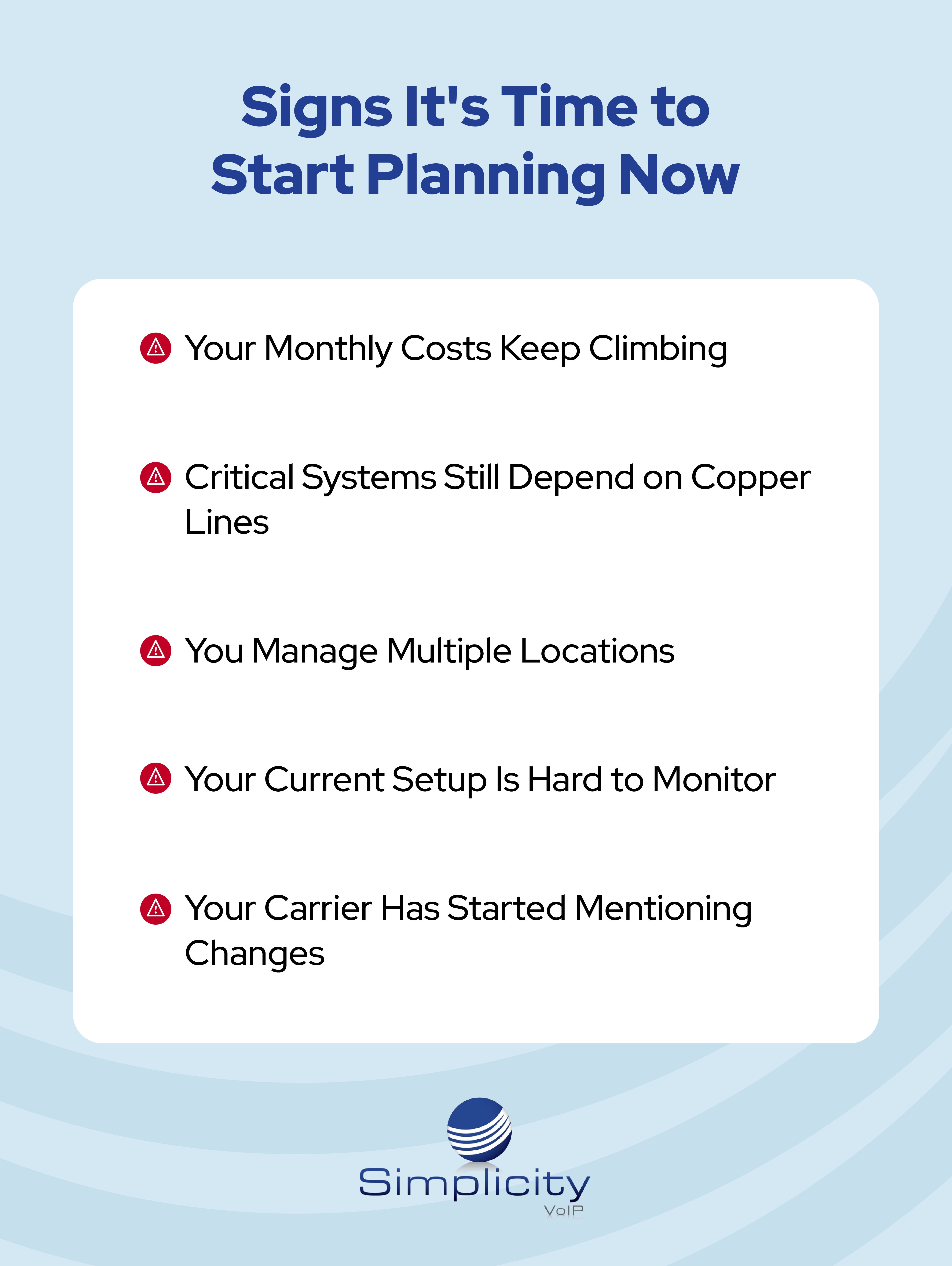
Some businesses assume they can wait another few years before addressing analog infrastructure. In reality, there are usually clear signs that it is time to start planning sooner rather than later.
Your Monthly Costs Keep Climbing
If your analog line bills continue increasing every year, it is probably time to evaluate alternatives.
Organizations don't realize how many active analog lines they still have until they conduct a full review across locations.
Critical Systems Still Depend on Copper Lines
If your alarms, elevators, fire panels, or emergency phones still rely on copper lines, having a transition plan in place is important.
The more critical the system, the less you want to depend on aging infrastructure with shrinking support.
You Manage Multiple Locations
Supporting analog infrastructure across several buildings or branch offices can quickly become difficult to manage.
A modern business POTS replacement solution can simplify deployment, improve visibility, and reduce the burden on internal teams.
Your Current Setup Is Hard to Monitor
Many legacy analog systems offer little to no visibility into connectivity or performance issues. That means teams often don't know there's a problem until something stops working.
Modern replacement solutions provide remote monitoring and management tools that make it easier to stay proactive instead of reactive.
Your Carrier Has Started Mentioning Changes
Some businesses are already receiving notices about pricing increases, infrastructure updates, or reduced support tied to copper networks.
If your provider has started discussing service changes, that's a strong sign it's time to begin evaluating your options before the situation becomes more urgent.
What to Look for in a POTS Replacement Solution
Not every solution is built for the realities of mission-critical analog systems. The right option should make the transition easier while improving reliability and long-term manageability.
Plug-and-Play Deployment
One of the biggest concerns around legacy line replacement is operational disruption.
Solutions that support plug-and-play deployment can help organizations transition quickly without major rewiring projects or downtime.
That's especially important for facilities supporting alarms, elevator systems, or emergency phones that can't afford long service interruptions.
Compatibility with Existing Analog Equipment
One of the biggest advantages of the right POTS replacement technology is the ability to support existing analog devices and existing equipment without requiring major rewiring projects. Many fire alarm systems, gate entry systems, point of sale systems, alarm systems, and elevator phones were specifically designed for analog phone systems and analog POTS lines.
Modern POTS line replacement options often use analog telephone adapters and cellular solutions to convert voice signals into digital signals that travel over internet protocol or wireless networks while still supporting analog phone connectivity for critical safety systems.
A reliable POTS in a box solution should work with existing analog equipment so businesses can modernize connectivity without replacing critical systems unnecessarily.
What Are the Options to Replace POTS Lines?
Organizations looking to replace POTS lines generally have several line replacement options available depending on their infrastructure, compliance needs, and internet connection reliability.
Common POTS line replacement options include:
- Cellular solutions using LTE or 5G wireless networks
- VoIP (Voice over Internet Protocol) solutions that route voice calls over digital networks
- Hosted cloud business communications platforms
- POTS in a box solutions designed for fire alarms, elevator phones, fax machines, and emergency systems
- Inventory existing analog lines
- Identify critical systems and dependencies
- Prioritize high-risk locations
- Budget appropriately
- Avoid rushed installations
- Reduce downtime risks
- Schedule deployments around business operations
A POTS in a box replacement solution is often one of the easiest ways to create a smooth transition because it allows businesses to keep using existing analog devices while moving away from copper infrastructure.
LTE Failover for Added Reliability
Redundancy matters when life safety or operational systems are involved.
Solutions with LTE failover help maintain reliable connectivity during outages or network disruptions, adding another layer of protection for critical devices. Many modern alternatives also include built-in battery backup features to help support emergency response communications during power outages.
Battery Backup Support
Power outages should not immediately disable emergency communication systems.
Battery backup capabilities help keep alarms, emergency phones, and other critical systems functioning during electrical interruptions.
Remote Monitoring and Management
Modern solutions should make life easier for IT teams.
Remote management capabilities allow organizations to monitor connections, troubleshoot issues, and manage deployments across multiple locations more efficiently.
Why Planning Early Leads to Better Outcomes
Organizations that start evaluating copper line replacement options early usually experience smoother transitions and fewer operational headaches.
Planning ahead gives teams time to:
Instead of reacting to outages or carrier deadlines, organizations can move on their own timeline and minimize disruption along the way.
That's especially important in industries like healthcare, education, property management, hospitality, and manufacturing, where communication reliability directly affects safety and day-to-day operations.
Start Planning Before It Becomes an Emergency

For many organizations, analog infrastructure has quietly become a growing operational risk.
Rising costs, aging copper networks, shrinking carrier support, and increased reliance on critical systems all point to the same conclusion: waiting too long to replace POTS lines can create unnecessary disruption, expense, and stress.
The good news is that transitioning away from copper infrastructure is often far more straightforward than organizations expect.
Simplicity VoIP’s POTS line replacement solution helps businesses modernize critical analog systems with plug-and-play deployment, analog compatibility, LTE failover, battery backup, and remote management designed to support business continuity. ned to support business continuity.
Instead of relying on aging POTS lines and traditional telephone service, businesses can transition to modern alternatives that support life safety compliance, emergency phones, and critical safety systems without replacing every analog phone or device already in place.
If your organization still relies on analog lines, now is a good time to start your POTS replacement planning process before service interruptions, rising costs, or compliance concerns become more urgent.
Simplicity VoIP can help. Just reach out today to start the conversation.