

If your business plans to send appointment reminders, service updates, follow-ups, promotions, or customer support texts, there’s one important step you can’t skip: 10DLC registration.
And while the process is meant to improve trust and reduce spam, many businesses quickly discover that getting approved is not always as simple as spending a few minutes filling out a form.
Incomplete information, weak opt-in language, unclear campaign details, and mismatched messaging examples are some of the biggest reasons businesses run into delays or outright rejections.
But the good news is that most 10DLC registration issues are avoidable.
In this guide, we’ll break down why registrations get delayed, what carriers are actually looking for, and how businesses can improve their chances of faster approval while staying aligned with long-term 10DLC compliance requirements.
What Is 10DLC Registration?
A2P (Application to Person) 10DLC registration is the process businesses use to verify their company information, messaging use cases, and phone number activity with mobile carriers before they send text messages through an A2P software provider.
The 10-digit long code system was created to help reduce spam, improve deliverability, and regulate business texting across carrier networks.
Businesses using SMS for customer communication must complete both brand registration and campaign registration through The Campaign Registry (TCR).
The Campaign Registry was created by major US mobile carriers as a centralized vetting process for A2P 10DLC messaging campaigns. During the registration process, businesses must complete brand registration using their company name, tax ID, employer identification number, and campaign details.
This process helps carriers verify:
- Who your business is
- What type of messages you send
- How customers opt-in
- Whether your texting practices follow carrier guidelines like age gated content
- Using a DBA instead of the registered legal business name
- Entering the wrong EIN
- Providing incomplete business addresses
- Submitting outdated websites
- Missing privacy policy or terms information
- Opt-in language is too vague
- There is no visible consent process
- Website forms do not mention SMS communication
- Customers are automatically enrolled without clear disclosure
- Privacy policies fail to explain texting usage
- That users are agreeing to receive text messages
- What types of messages they will receive
- Whether message and data rates may apply
- How customers can opt out
- That customer information will not be shared or sold when applicable
- Clearly identify your business
- Match the stated campaign use case
- Sound realistic and professional
- Include opt-out language when appropriate
- Registering for customer support texts but sending promotions
- Claiming conversational messaging but using bulk marketing campaigns
- Listing appointment reminders while planning lead generation campaigns
- Privacy policy
- Terms and conditions
- SMS disclosure language
- Contact information
- Visible opt-in explanation
Without proper 10DLC campaign registration, businesses may face message filtering, blocked delivery, or restrictions on outbound text messages across carrier networks.
Registered A2P 10DLC campaigns support higher throughput, better deliverability, and more reliable business texting compared to unregistered business phone numbers.
Businesses should also understand that there are Campaign Registry fees associated with registration. These fees are tied directly to carrier compliance requirements and affect whether your messages actually reach customers.
Why 10DLC Registration Gets Delayed or Rejected
Most problems happen because submitted information doesn't clearly match the business’s actual texting practices. If details feel incomplete, vague, or inconsistent, the registration may be delayed or rejected.
Incomplete or Incorrect Business Information
Your legal business name, EIN, website, address, and contact information must all match official records.
Common issues include:
Even small inconsistencies can trigger additional review and slow the approval process.
Weak or Missing Opt-In Language
One of the most important 10DLC requirements involves documenting how businesses collect opt-ins and receive consent from customers to receive messages.
Opt-in compliance is one of the biggest areas carriers evaluate during 10DLC campaign registration.
Many campaigns get flagged during campaign vetting because:
For example, simply saying “Submit your information” on a website form is usually not enough.
Carriers expect businesses to clearly state:
Simplicity’s knowledge base also emphasizes that consent must be initiated by the individual receiving messages and can't be automatically assumed.
Strong opt-in information helps support both 10DLC compliance and customer trust. Businesses should also include clear opt-out language, opt-out instructions, message frequency disclosures, and statements that message frequency varies, and data rates may apply.
Some businesses rely on verbal opt-ins, while others collect them through registration forms, website forms, or software application workflows. Regardless of the method, businesses must maintain documentation showing how customers agreed to receive messages.
Poor Sample Messages
The Campaign Registry requires businesses to submit sample messages that match the campaign type and actual customer experience.
Many businesses submit weak examples or provide messages that don't accurately reflect real-world usage.
Your sample messages should:
Weak examples often look like this:
“Reminder: You have an appointment tomorrow.”
A stronger example would be:
“Hi Sarah, this is Simplicity Dental confirming your appointment on Thursday at 2 p.m. Reply STOP to opt out.”
This type of message provides clarity, identifies unknown senders, and aligns with compliance expectations.
Mismatch Between Submitted Use Case and Actual Messaging
A2P 10DLC campaign registration depends heavily on consistency between your submitted campaign name, campaign type, and actual messaging behavior.
Problems also happen when businesses describe one type of campaign but plan to send entirely different messages.
For example:
Carriers compare your campaign description, opt-in process, website content, and sample messages together.
If they do not align, approval may stall.
Consistency matters throughout the entire registration.
Missing Website Compliance Elements
Most businesses also need website content that supports complete brand registration and successful registration approval.
If your site lacks key compliance information, carriers may reject the registration.
Common missing elements include:
Even basic business texting registration submissions should include a professional online presence that explains how customer information is collected and used.
Using Shared or Unverified Numbers
Businesses should also avoid registering shared or unverified business phone numbers. Carriers want clear accountability for all collected phone numbers, and ownership issues can delay successful registration.
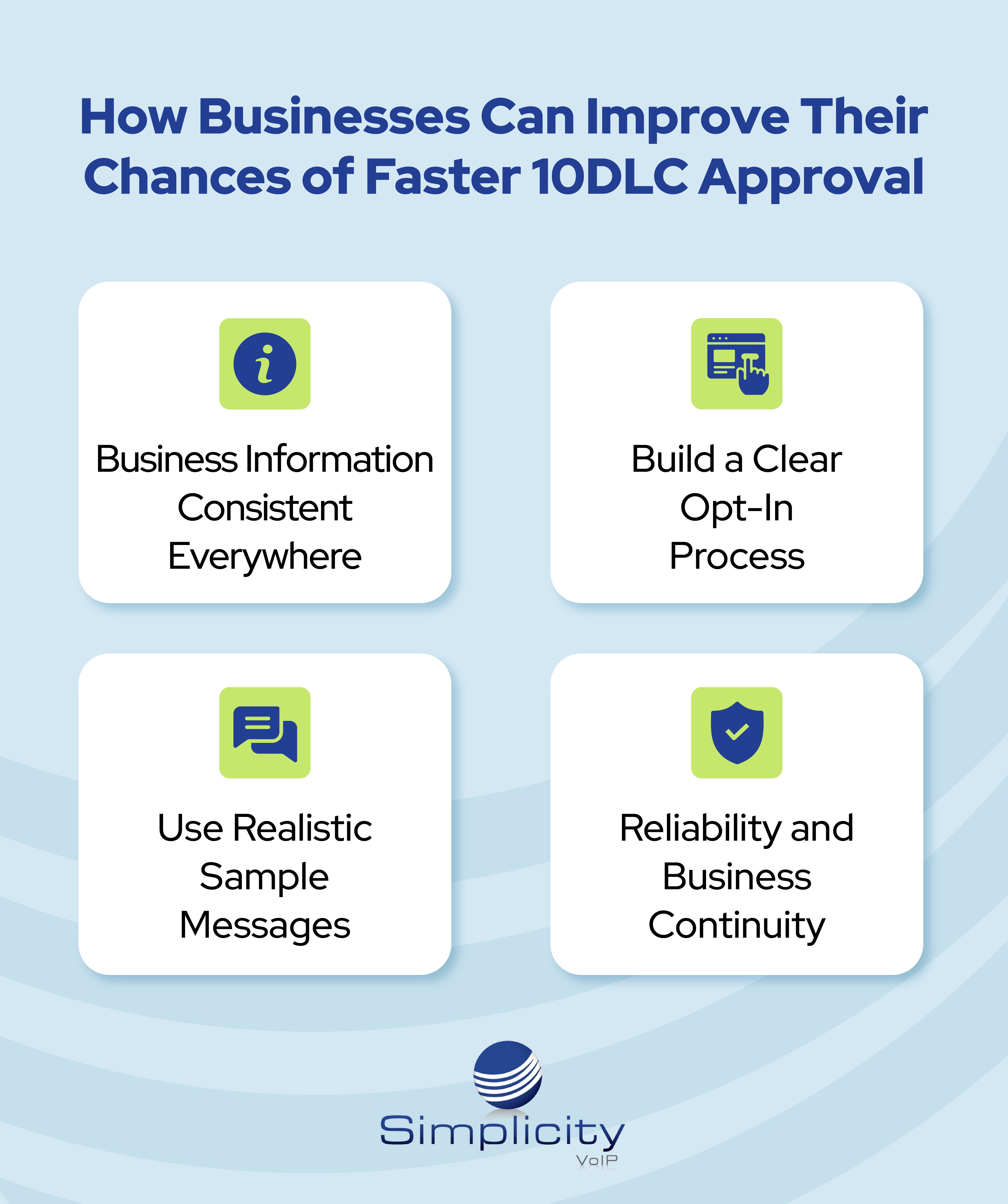
How Businesses Can Improve Their Chances of Faster 10DLC Approval
Businesses that complete registration correctly are more likely to receive approval within a week after manual review begins, although the full approval process can take up to several weeks, depending on campaign vetting requirements.
The easiest way to avoid delays is to treat 10DLC registration as a business verification process rather than a simple technical setup.
Keep Business Information Consistent Everywhere
To register for A2P 10DLC successfully, businesses should ensure all campaign service provider details align across public records, websites, and carrier submissions.
All submitted information should be verified prior to starting registration, including your:
- Legal business name
- Tax ID / EIN
- Business Type
- Company Status
- Website
- Address
- Contact details
- Industry
- Clear consent language
- Disclosure of message frequency
- Opt-out instructions
- Links to privacy policies
- Separate consent checkboxes when appropriate
- Language explaining that customer information is protected and not sold or shared
- Identify the business name
- Match the campaign type
- Use natural wording
- Include opt-out instructions when required
- Sending unsolicited texts
- Changing campaign behavior without updating registration
- Using purchased contact lists
- Ignoring opt-out requests
- Brand registration requirements
- Campaign registration documentation
- Business verification details
- EIN submission
- Campaign use cases
- Sample messages
- Opt-in workflows
- Privacy policy requirements
- Website compliance readiness
- Campaign Registry submission requirements
These should match official records and public-facing information.
Consistency helps carriers quickly verify legitimacy.
Build a Clear Opt-In Process
Businesses should make SMS consent obvious and transparent because the opt-in process is one of the biggest factors carriers review during campaign approval.
Good opt -in workflows typically include:
Businesses using web forms should place consent language directly near the submission area instead of hiding it inside separate terms pages.
Use Realistic Sample Messages
Businesses that send messages for appointment reminders, account notifications, inbound message support, or promotional offers should ensure their sample messages accurately reflect their messaging campaigns.
Sample messages should reflect actual customer communication, including:
Avoid generic placeholder examples or overly promotional language if your campaign is primarily service based.
Align Your Campaign Description with Actual Usage
Every SMS campaign should include a detailed description explaining why the business plans to send application-to-person traffic and how customers opted in.
Be specific about how your business plans to use texting.
Instead of vague descriptions like:
“Customer communication.”
Use something more detailed:
“Appointment reminders, customer support follow-ups, and service scheduling updates for existing customers.”
What Is the Difference Between A2P 10DLC, Toll-Free Numbers, and Short Code Messaging?
Many small businesses compare A2P 10DLC, toll-free numbers, and short code messaging before choosing a messaging solution.
A2P 10DLC allows businesses to use a local phone number for two-way communication and send SMS messages at higher throughput rates than traditional unregistered lines.
Toll-free numbers are another option for business texting, but they often involve different verification standards.
Short code messaging is commonly used for large-scale bulk messaging campaigns because short code numbers can send more messages quickly, but short code programs are significantly more expensive.
For most businesses, A2P 10DLC offers a more flexible option for conversational messaging campaigns, customer support, and SMS communication.
Why 10DLC Compliance Is Ongoing
Many businesses assume registration is the finish line. In reality, 10DLC compliance continues after approval. Carriers monitor messaging behavior over time.
Businesses can still face message filtering, throughput restrictions, campaign suspension, or number blocking if their texting activity does not align with approved use cases.
That’s why businesses should avoid:
Long-term compliance depends on maintaining responsible texting practices.
10DLC compliance also helps businesses align with FCC guidelines, Telephone Consumer Protection Act requirements, and Cellular Telecommunications Industry Association standards designed to protect consumers and mobile information from spam and fraud.
How Simplicity VoIP Helps Businesses Navigate Business Texting Registration
For many SMBs, the most frustrating part of 10DLC campaign registration is figuring out what carriers actually want.
It’s not just about activating SMS. Businesses need to provide the right documentation, explain their messaging use cases clearly, and follow evolving compliance requirements.
Simplicity’s Chat & SMS solution gives businesses a practical way to manage customer texting while supporting the requirements tied to business texting registration, and ongoing compliance.
The onboarding process helps businesses prepare key registration elements like:
Simplicity VoIP also helps businesses understand what information carriers expect before campaigns are submitted, which can help reduce avoidable delays and rejections during the 10DLC approval process.
Businesses Must Understand That Registration Is No Longer Optional

Mobile carriers now require businesses to verify their campaigns before they start texting using a standard 10-digit long code phone number.
Whether you are a sole proprietor managing one campaign or a growing company running multiple campaigns, the ability to complete registration accurately can directly impact message throughput, deliverability, and customer trust.
The businesses most likely to receive approval quickly are the ones that provide accurate campaign details, maintain compliant opt-ins, use realistic sample messages, and align their campaign type with actual messaging behavior.
For companies preparing to launch texting the right way, Simplicity VoIP’s Chat & SMS platform helps simplify the path toward successful 10DLC approval and compliant business messaging.
Get in touch so we can help you get started!