
If your business is still running on a traditional phone system, you might be wondering if now’s the time to switch. Maybe you’ve heard terms like “hosted VoIP,” “internet phone systems,” or “cloud communications” floating around, but haven’t had the time to sort through it all.
Here’s the good news: You don’t need to be a tech expert to understand what hosted VoIP is or how it compares to your old system.
You just need the right guide. And would you look at that - you're already here!
Below, we'll unpack what makes hosted VoIP phone systems different from traditional PBX systems in five important areas:
- Cost,
- Features,
- Scalability,
- Mobility, and
- Maintenance
We'll help you see if now's the time to upgrade to a VoIP service provider.
First Things First: What Is Hosted VoIP?

Hosted VoIP stands for hosted Voice over Internet Protocol (VoIP), and it's a technical way of saying your phone service runs over the internet instead of traditional phone lines.
The “hosted” part means the equipment, servers, and software needed to run your phones live in the cloud. You don’t have to buy or maintain any of that. You just connect your phones (or apps) to the internet, and the service provider (like Simplicity VoIP) takes care of the rest.
Think of it like Netflix.
You don’t buy DVDs or a DVD player. You stream movies from a service that runs everything behind the scenes. Hosted VoIP works the same way, but for your business calls.
Quick Note: VoIP isn't the Same Thing as Hosted VoIP. Here's Why.
Let's clear this up: VoIP and hosted VoIP are related, but they are not the same thing.
VoIP is the big picture category. It's the technology that allows phone calls to travel over the internet (instead of old phone lines). It's what powers cloud communications as we know it.
Hosted VoIP is a type of VoIP-powered phone system where the phone system lives in the cloud, and the provider runs it for you. Here’s the simplest way to compare:
- VoIP (general): “Calls use the internet.”
Your phone system could be hosted in the cloud, or it could be your own equipment on-site. - Hosted VoIP: “Calls use the internet, and the provider hosts the system.”
No on-site phone server to babysit, and updates/support are handled behind the scenes.
Thus, two businesses can both “have a VoIP system,” but that doesn't mean their setup will look the same.
What Is a Traditional Phone System?
Traditional systems include old-school landlines or on-site PBX setups (private branch exchanges). These are the physical phone boxes that sit in a closet or server room, usually hooked up to copper wires from the phone company.
If you’ve ever had to call a technician to “come fix the phone system,” chances are it was a traditional PBX. These setups often use analog lines, and any upgrades or changes usually require hardware.
While these systems worked well for many years, they’re starting to show their age, especially in today’s hybrid world.
VoIP vs. On-Premise Business Phone Systems: Comparison Points to Consider
Now that you know the differences between how the two options function, let's talk about their differences in practice.
First, Let's Compare on Cost (Because Everyone Does)
Most businesses start the hosted VoIP conversation with the same question: “Is this going to save money, or just move costs around?”
With a traditional phone system, costs often show up in bigger chunks. There’s equipment to buy, someone to install it, and then surprise costs when something breaks or needs an upgrade.
With a hosted VoIP solution, the system lives in the cloud. That usually means less on-site gear, fewer repair bills, and simpler monthly pricing.
What costs tend to look like:
- Traditional PBX: Upfront hardware + installation + repair/upgrade bills
- Hosted VoIP: Monthly per-user plan + (maybe) desk phones if wanted
Typically, this means a hosted VoIP service is much cheaper over time than an older communication system.
Next Up: Flexibility and Mobility
Once the cost is clear, most businesses get practical: What happens when someone works from home, travels, or bounces between locations?
Traditional systems were built for desk phones in one building. Remote support is possible, but it usually requires adding a VPN or other third-party tools, which can get complicated fast.
Hosted VoIP is built for mobility. Since it’s part of cloud phone systems, calls can ring on a desk phone, a computer, or a mobile app. Same number, same experience, different device.
A quick real-life example: If the office closes early because of the weather, voice calls can still be answered from home without changing the main business number.
Hosted PBX: Calls follow the person, not the building.
Traditional PBX: Best for on-site calling; remote use often takes add-ons.
Then, Let's Compare Quality and Availability of Features
This is where VoIP vs. PBX gets really obvious. Hosted VoIP systems are software-based, so a lot of “nice-to-haves” are usually built in.
Here are just a few everyday features that are included with most cloud-based phone systems:
- Auto-attendant: Professional call menus like “Press 1 for Sales” are built in.
- Smart call forwarding and routing: Route calls by team, time of day, or availability without manual transfers.
- Voicemail-to-email: Messages go straight to inboxes so nothing slips through the cracks.
- Call recording: Great for training, quality checks, or recordkeeping.
- Call reports and analytics: Track call volume, missed calls, and response times.
- Softphone apps: Make and take business calls from your computer or smartphone.
With a traditional PBX? Most of these require:
- Extra licensing or equipment
- Help from a vendor or IT team
- Time (and budget) to install and manage
That’s why business VoIP benefits go beyond “internet calling.” They also provide modern tools without building a complex, patchwork communication system.
Hosted PBX: Advanced features are included and updated automatically.
Traditional PBX: Limited feature libraries unless you invest more energy, money, and time.
Finally, Let's Talk Maintenance
Maintaining an on-site PBX system means owning the problems that come with it. If something breaks, it’s up to you to get it fixed, often with help from a technician (and a bill). Older systems are being phased out and can be harder to repair, especially if the parts are outdated.
With hosted VoIP, your provider keeps everything running. They handle updates, security patches, support, and even future-proofing. If something goes wrong, you call them, not an outside repairperson.
It’s one less system for your team to babysit, which means more time spent actually working.
In short:
- Hosted VoIP: Support and updates are part of the service
- Traditional PBX: You manage equipment, maintenance, and repairs
Now that we've covered some of the ways VoIP systems tend to outperform traditional PBX systems, let's sum everything up.
Hosted PBX Systems vs. "Traditional" PBX: What’s the Real Difference?
Here’s a simple side-by-side look to help compare:
|
Feature |
Hosted VoIP |
Traditional PBX |
|---|---|---|
|
How It Works |
Runs over the internet; cloud-based |
Uses copper lines or on-site hardware |
|
Setup Costs |
Low or no upfront hardware |
High upfront equipment cost |
|
Maintenance |
Handled by your provider |
Requires in-house IT or outside techs |
|
Scalability |
Add/remove users in minutes |
Hardware limits growth |
|
Remote/Mobile Use |
Easy with apps or softphones |
Often requires VPNs or complex setups |
|
Features |
Call routing, voicemail to email, video, chat |
Mostly voice, unless you buy upgrades |
|
Reliability |
Highly reliable with internet backup options |
Can go down with power or phone line issues |
Still got questions? Don't worry, we have a section for that.
FAQs + Answers About Hosted VoIP

We hear a lot of questions about VoIP technology, but here are the most common ones. We hope they help you!
1) Is hosted VoIP the same as a cloud phone system?
Most of the time, yes. “Cloud phone systems” is the category, and hosted VoIP is a common type inside that category.
2) Do you need special phones for hosted VoIP?
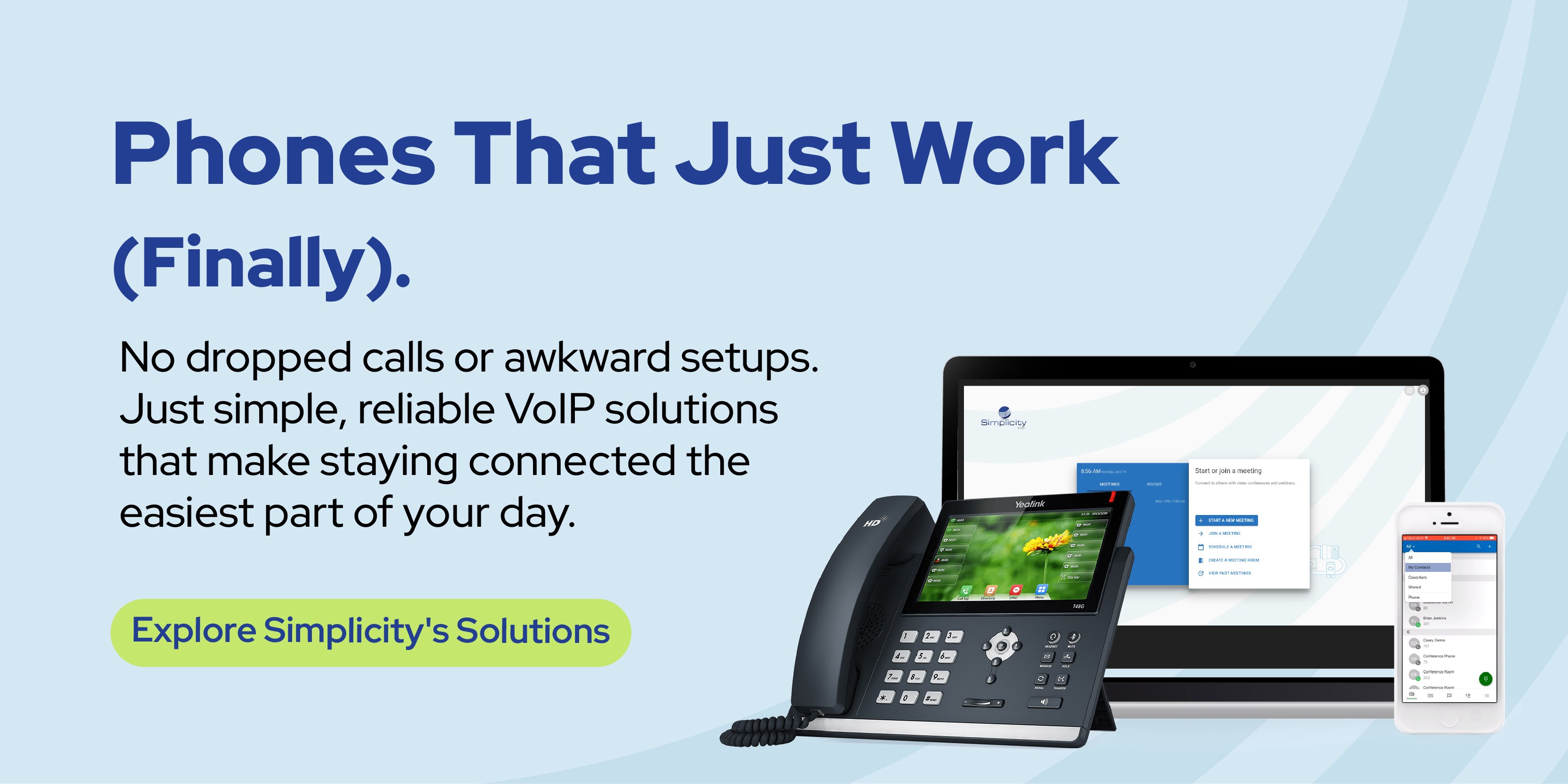
Not always. Many businesses choose new IP phones for the best experience, but some setups can reuse existing equipment depending on the hardware and plan. With a solution from Simplicity VoIP, you can use our softphones on everything from laptops to tablets and smartphones.
3) Is call quality better or worse than traditional landlines?
It depends on the internet quality and setup. With strong internet and a properly configured network, hosted VoIP can sound just as clear as (if not clearer than) traditional service.
4) What happens if the internet goes down?
Calls need an internet connection, but hosted VoIP has built in redundancy, equipped with 4G LTE failover to keep the business reachable. And, with the mobile app and softphones, you can circumvent almost any downtime.
5) Is hosted VoIP secure?
Yes, when the network is set up correctly. With businesses facing literally millions of cyber attacks per year, it has to be. Selecting a VoIP provider that is committed to security is a first step, but there are many with tools like VPNs, multi-factor authentication, and strong password policies, you can implement to protect your phone system. Click here to learn more about Cybersecurity for VoIP.
6) Can a business keep its current phone numbers?
In most cases, yes. The process is called number porting, which means moving the number from the old provider to the new one.
7) Is hosted VoIP good for hybrid or remote teams?
Yes. That’s one of the biggest benefits. Cloud communications let employees answer and make business calls from anywhere, using the same work number.

So, Which One Is Right for Your Business?
Here’s a quick way to think about it:
Choose hosted VoIP if. . .
- Your team works remotely, travels, or uses mobile devices
- You’re tired of surprise repair costs
- You want built-in features without nickel-and-diming
- You need to scale up (or down) quickly
- You’re planning for hybrid work or digital transformation
Stick with traditional phones if. . .
- You already invested heavily in hardware and don’t plan to change soon
- Your team never works remotely and won’t in the future
- You don’t need new features and don’t mind paying for upgrades or repairs
However, even then, it’s worth reviewing. Many businesses that thought they “weren’t ready” for VoIP find it’s easier (and more affordable) than expected.
Make Communication Easier with Simplicity VoIP
If your phones are costing too much, slowing things down, or stuck in one place, hosted VoIP is a smarter way forward.
With Simplicity VoIP, the switch doesn’t have to be complicated. We make it easy to modernize your phone system, support hybrid teams, and finally stop worrying about outages, hardware, or surprise bills.
Just request a quote when you're ready. We’ll walk you through it, step by step. Simple as that.