
There’s a traditional PBX box in the closet that no one wants to touch. It overheats in the summer, blinks ominously in the winter, and costs a fortune every time it needs attention. Want to update your auto attendant or call forwarding? That’s a support ticket. Need to add a new user? Hope your IT guy’s available.
This is exactly why more businesses are moving to a hosted phone system.
Instead of relying on on-site hardware and expensive service calls, hosted phone systems move the entire setup to the cloud.
This guide breaks down what a hosted phone system is, how it works, how it compares to on-premises and hybrid systems, and who gets the most value from it.
What Is a Hosted Phone System?
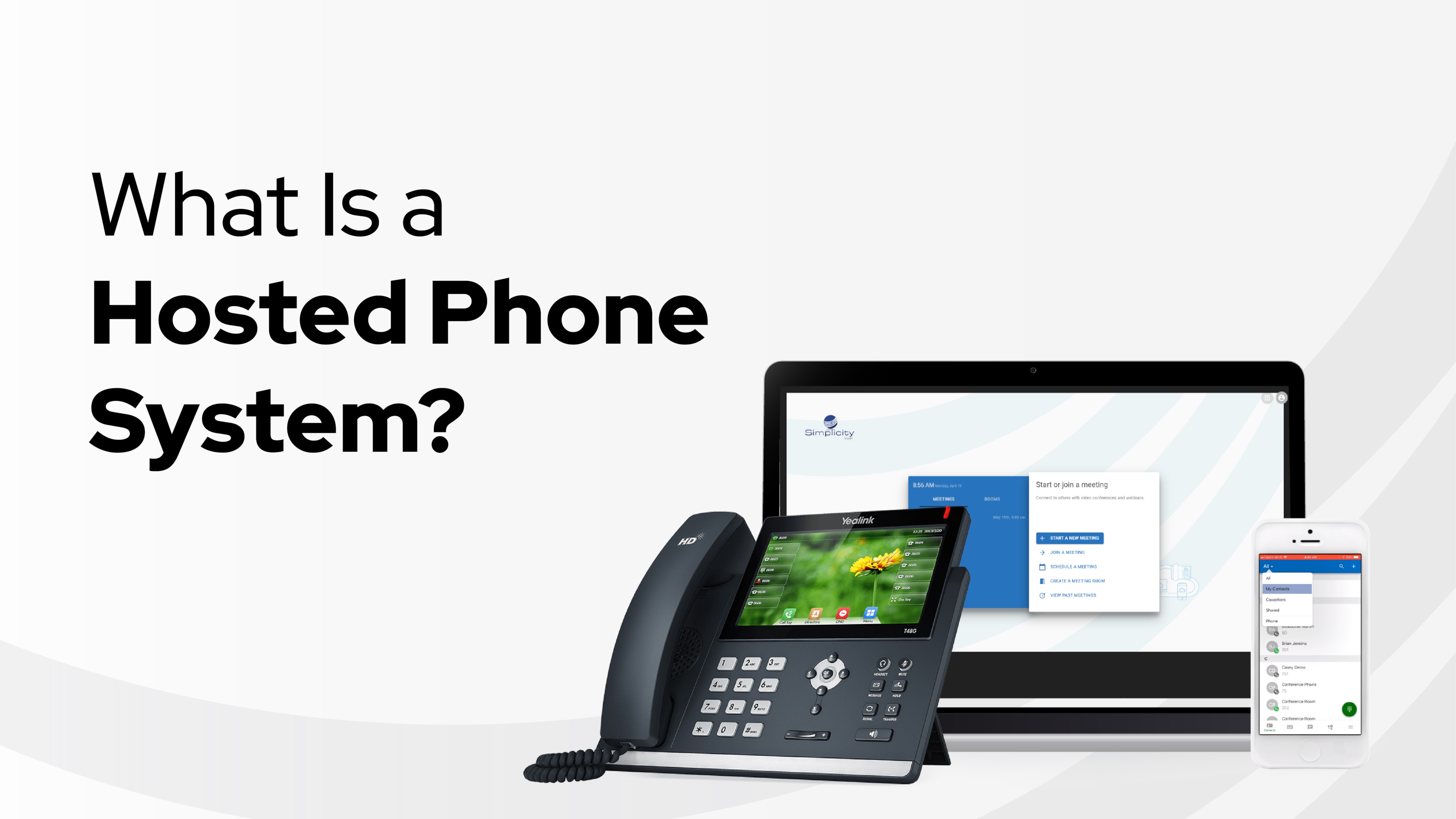
A hosted phone system is a business phone system that runs over the internet and is managed off-site by a service provider.
In other words, instead of having physical phone equipment in your office (like that clunky PBX on the wall), the “brains” of your phone system live in the cloud, a.k.a. remote servers that your provider maintains, upgrades, and secures.
This type of system is often referred to as:
-
Hosted VoIP (Voice over Internet Protocol)
-
A hosted PBX (Private Branch Exchange)
No matter the name, the concept is the same: you use phones in your office (or softphones on a computer or mobile app on a cell phone), and those phones connect to your provider’s cloud-based infrastructure over the internet.
So, How Does a Hosted Phone System Actually Work?
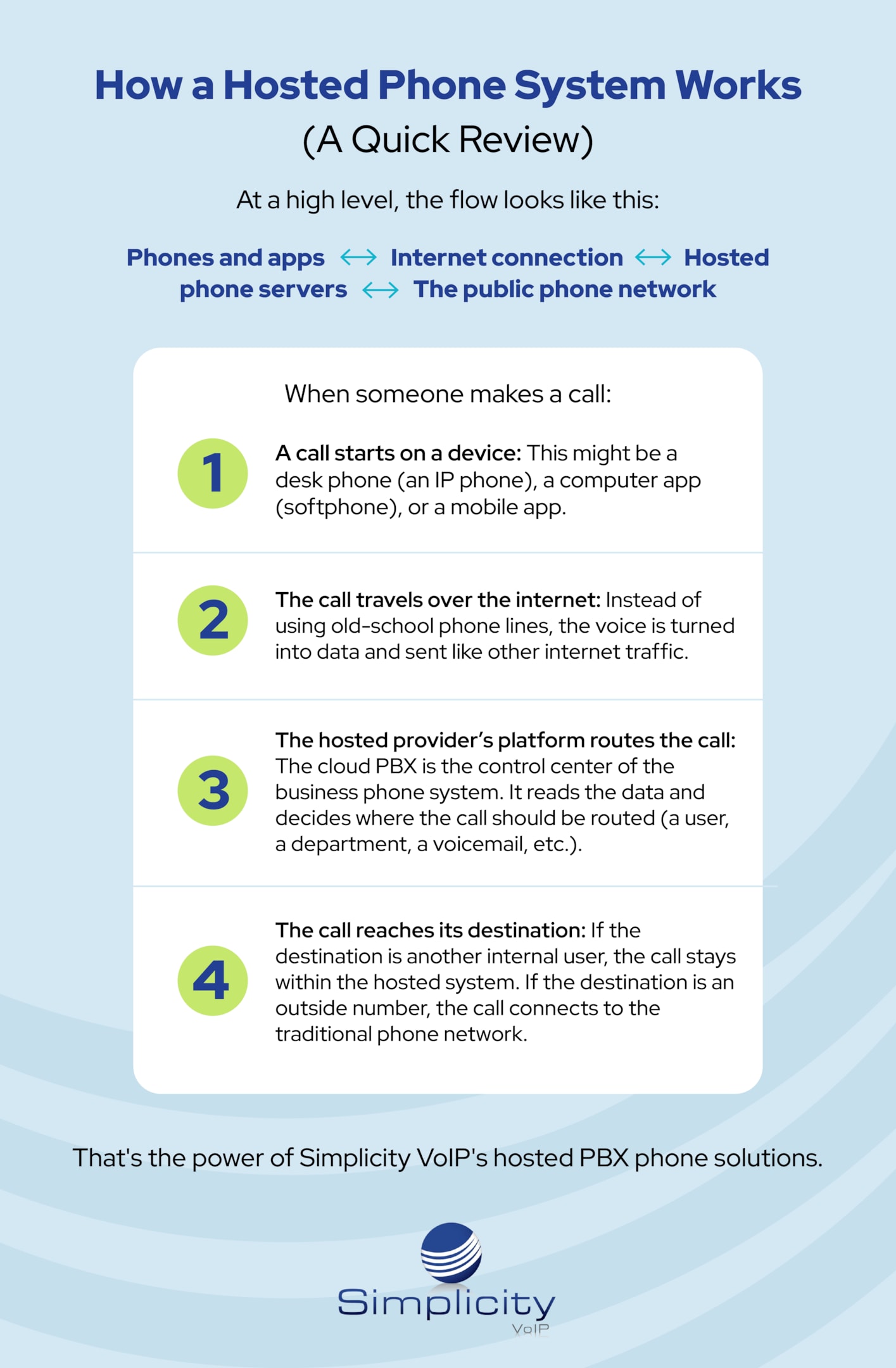
A hosted phone system might sound complicated, but the idea is simple. Your voice calls travel over the internet instead of through old copper phone lines, and the “phone system” lives in the cloud with your provider instead of in your building.
Here is how that works, step by step.
Step 1: You Start a Call on a Device
Everything starts when someone on your team makes a call using a VoIP desk phone or a softphone application that's connected to your office network or Wi-Fi.
Step 2: Your Voice Turns into Data via VoIP
As soon as the person starts talking, the phone or app converts their voice into digital information. This is where VoIP comes in.
VoIP (Voice over Internet Protocol) is the technology that turns sound into tiny data packets so it can travel across the internet. It works in a similar way to how emails or video streams are sent.
So instead of sending an electrical signal over a phone line, your phone system:
-
Listens to the voice
-
Breaks it into small chunks of data
-
Packages those chunks so they can be sent over the internet
These data packets travel from the device, through your router, and out to your hosted phone provider.
Step 3: SIP Sets Up and Manages the Call
Now the call needs instructions. That job belongs to Session Initiation Protocol (SIP). SIP is a set of rules that controls call sessions, or the time when two or more people are connected on a call.
SIP tells the system:
-
Who is calling whom
-
Where to send the call
-
Which devices are involved
-
When the call starts and ends
A simple way to think about SIP:
-
VoIP is the way your voice becomes data
-
SIP is the way your phone system decides how that data is used and where it goes
SIP is like a virtual switchboard operator that ensures each call is set up correctly, connected to the right destination, and closed when everyone hangs up.
Step 4: Your Call Reaches the Cloud Servers
Once VoIP converts your voice into data and SIP sets up the call, the call flows to your provider’s cloud servers, where the hosted PBX software runs.
From there, the software:
-
Routes the call to the correct person or outside number
-
Applies your rules (if any), such as business hours, call menus, and ring groups
-
Logs details for call history and analytics
-
Stores voicemails or recordings if needed
All of this happens in the cloud, not in a server room at your office.
Step 5: The Call Connects to the Other Person
Finally, the call is delivered (and it only took a few nanoseconds).
If the call is going to another VoIP user, the process looks similar on their side, just in reverse. If it is a landline or mobile number, your provider connects your VoIP data into the public switched telephone network (PSTN), so it behaves like a normal phone call.
To the people talking, it feels like a regular call. In the background, VoIP, SIP, your router, and your hosted PBX provider's software work together to ensure everything is fast and reliable.
Got questions about any of these acronyms or functions? Check out our VoIP FAQ & Glossary.
Why This Matters for Your Business. . .
Walking through this process shows why hosted PBX systems are so flexible:
-
Calls are not tied to one building or one set of phone lines
-
The “brains” of the system live in the cloud, where they can be updated and monitored
-
Your team only needs devices, an internet connection, and access to the hosted system
The result is a phone system that feels familiar to use, but is much easier to manage, grow, and support than traditional on-site hardware.
In fact, to set up a hosted PBX service:
-
A solid internet connection
-
A router and network setup that can prioritize voice traffic
-
Phones or laptops capable of downloading apps
-
A hosted provider (the platform running the PBX features)
That’s it. The plug-and-play simplicity is one of the many reasons hosted PBX phone systems have become so popular.
Why Businesses Are Choosing Hosted Phone Systems
Now that we know how they function, let’s look at what hosted phone systems really bring to the table on a daily basis.
First, they’re remote-ready by design.
Because calls travel over the internet, your team can answer from anywhere: the office, the home, or even the airport terminal. Mobile apps keep everyone connected, with business caller ID and voicemail right at their fingertips.
Second, they eliminate hardware headaches.
No more dealing with aging PBX equipment or waiting on a tech to make simple changes. Your provider handles the infrastructure and offers web-based tools so your admin can update users, greetings, or call routing with a few clicks.
Third, they grow with you.
Need to add a user? No problem. Scaling up (or down) doesn’t require a massive investment, just a few updates to your plan. This makes hosted systems ideal for seasonal businesses, expanding teams, or organizations with multiple locations.
Fourth, they help achieve cost savings
Instead of spending thousands upfront, you get a predictable monthly cost that often includes support, maintenance, and software upgrades. It’s easy to plan for, and there are no surprise invoices when equipment breaks.
And finally, they unlock advanced features.
From auto-attendants and voicemail-to-email to call analytics and CRM integrations, hosted systems deliver enterprise-grade tools to businesses of any size, without requiring expensive add-ons or hardware.
Unlike many of the older, more traditional PBX systems.
Hosted PBX Solutions vs. Traditional Phone Systems
At first glance, both systems ring phones, route calls, and keep customers connected. The big difference is where the heavy lifting happens.
Here’s how hosted and on-site phone systems compare:
|
Feature |
Cloud-Based Phone System |
On-Premises Phone System |
|---|---|---|
|
Where it’s managed |
In the cloud, by your provider |
On-site, by your team or IT vendor |
|
Startup costs |
Lower; no big hardware purchase needed |
Higher; requires buying PBX hardware upfront |
|
Scalability |
Easy to scale up or down |
More hardware is needed to grow and is often capped at a user limit |
|
Maintenance |
Handled by the provider |
Requires in-house support or paid technicians |
|
Remote work support |
Built-in |
Requires extra configuration |
|
Reliability and updates |
Provider handles security and software updates |
You must manage updates and security patches |
If you want more flexibility, less hardware, and built-in support for hybrid work, a hosted phone system is usually the better choice.
To dive deeper into the pros and cons of on-prem vs. cloud-based business communications, check out this blog post!
The Top 5 Hosted Phone System FAQs (and Their Answers)
Still got questions? We've got answers! These are the questions we hear most from business owners and IT managers who are figuring out if hosted is the right fit.
Let’s clear a few of them up.
Q: Does it still work if the internet goes down?
A: Your phones need an internet connection to place or receive calls. However, most hosted phone systems let you forward calls to mobile numbers, route to voicemail, or use failover options if your office loses internet temporarily.
Q: Is my data secure?
A: Yes (with the right provider). Simplicity VoIP uses secure data centers, encrypted connections, and built-in safeguards to protect your call data and recordings. Always ask about compliance when handling sensitive information (e.g., in healthcare or finance).
Have more questions about data security? Check out our cybersecurity 411.
Q: Will my call quality take a hit on a VoIP phone system?
A: With a strong internet connection and a good provider, voice call quality can be crystal clear (often better than traditional landlines).
Q: How do most VoIP providers structure pricing?
A: Typically, they offer plans based on the number of users and feature tiers. That means no need for big upfront hardware investments, just predictable, subscription-style pricing that scales with your needs.
Q: Will 911 work the same way as it does on a landline?
A: Yes, as long as the address attached to each user stays up to date. Hosted systems use E911 (Enhanced 911) to send your registered address to emergency services. If someone works remotely or moves desks, that address needs to be updated in the system so help goes to the right place.
Bonus Question: Who benefits most from a hosted phone system?
A hosted phone system can work for almost any SMB, but it is especially helpful for:
-
Remote and hybrid teams that need the same phone experience everywhere
-
Multi-location businesses that want one system across offices and job sites
-
Seasonal businesses that scale users up and down throughout the year
-
Lean IT teams that would rather not maintain another on-site server
-
Customer-facing teams that need call queues, call routing, and better visibility
Really, anyone can benefit from hosted PBX solutions. Especially if they partner with Simplicity VoIP.
Enjoy Less Hardware, Fewer Headaches, and Better Conversations with Simplicity VoIP
Hosted phone systems take the heavy lifting out of business communications. No PBX to babysit, no surprise repair bills, no waiting days for simple changes.
Simplicity VoIP delivers a clean, cloud-based solution backed by a team that understands how critical reliable calling is to daily operations.
If the goal is a modern phone system that just works, it starts here. Request a quote today!