

If your business still has a few copper phone lines on the bill, you've probably wondered whether it's time to move everything to VoIP. Maybe your desk phones already run over the internet. Maybe nobody's quite sure what the line in the elevator room connects to.
The catch is that POTS and VoIP aren't interchangeable. Your staff and your elevator phone need very different kinds of service, and most buildings need both.
In short, POTS uses analog signals over copper lines, while VoIP uses digital signals over the internet.
This blog covers how each one works, why POTS lines are going away, and how to figure out which systems in your building need which service.
What Is the Difference Between POTS and VoIP?
POTS stands for plain old telephone service. It sends analog voice transmission over copper wires, using analog electrical signals that follow a dedicated path from your phone jacks to the carrier's switch. The technology dates back to the late 19th century, when Alexander Graham Bell sketched his telephone design in 1876, so it's well over 100 years old. It was great back in the day, but a lot has changed since then.
VoIP stands for Voice over Internet Protocol. Per the FCC's consumer guide to VoIP, VoIP converts voice from your phone into a digital signal that can travel over the internet, then back again at the other end if you're calling a regular number. You'll also hear it called internet telephony or IP telephony.
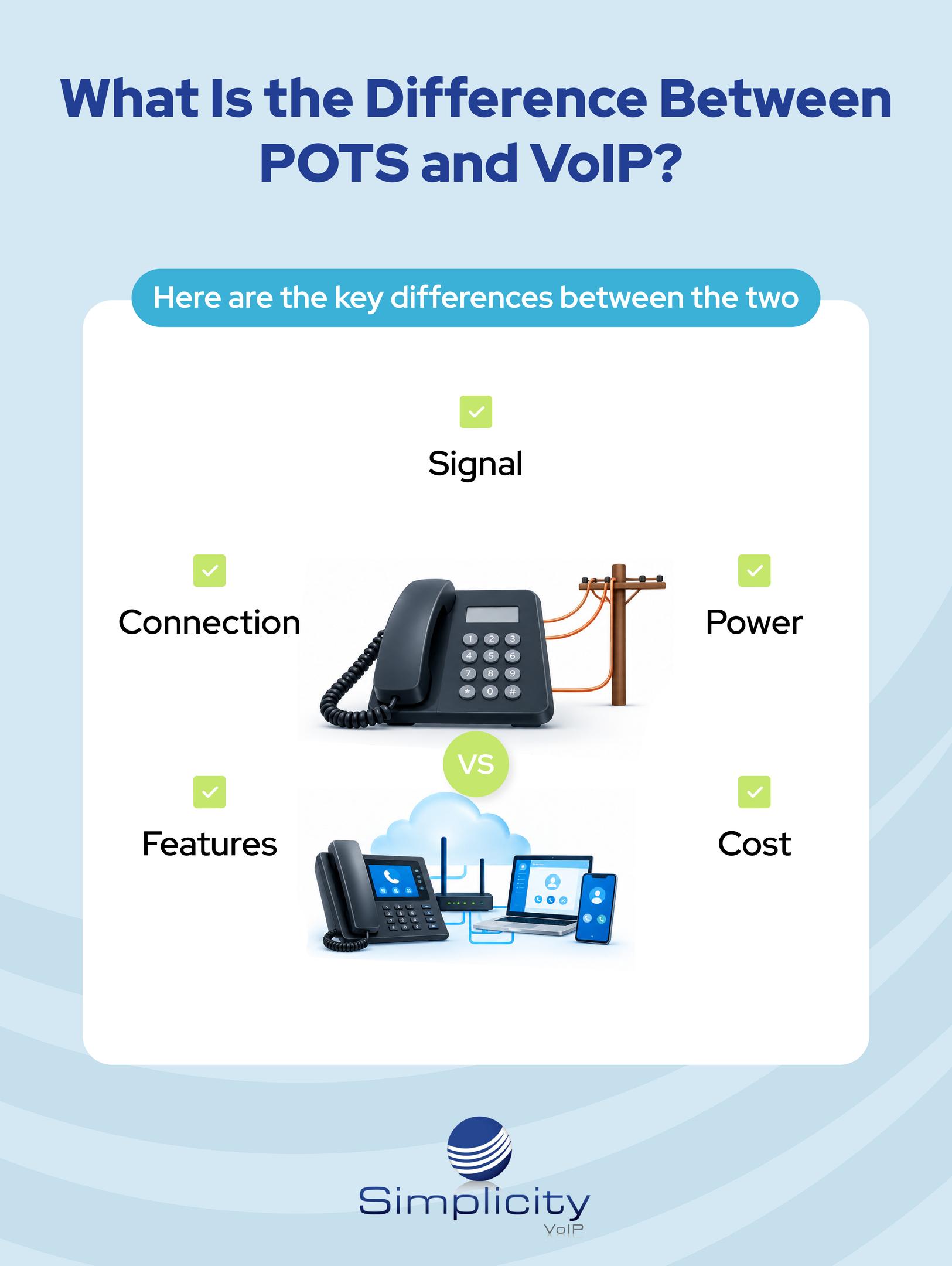
Here are the key differences between the two:
- Signal: POTS sends an electrical signal over copper. VoIP sends digital signals, turning voice data into digital data packets.
- Connection: A POTS landline uses a dedicated connection. VoIP traffic shares your business internet connection with other data.
- Features: POTS gives you a dial tone and basic calling. VoIP systems add advanced features like call forwarding, voicemail transcription, voicemail-to-email, video calls, and video conferencing.
- Power: POTS lines draw power from the phone company's network, which is why traditional landlines often keep working during local power outages. VoIP relies on local electricity and internet access, so it needs backup power to stay up during power outages.
- Cost: POTS generally carries higher long-distance calls and international fees. A VoIP service is usually more cost-effective, especially for long-distance.
How Does PSTN Fit Into POTS vs VoIP?
The public switched telephone network (PSTN) is the global network of telephone lines, fiber optics, cellular links, and switching centers that connects telephone calls. POTS is the oldest service on it. The switched telephone network was built on circuit switching, which holds one dedicated path open for the whole call.
VoIP doesn't replace the PSTN overnight. When you call a regular number, VoIP calls still hand off to the telephone network at the far end. Many businesses connect through SIP trunks, which carry SIP calls between their phone system and the PSTN.
Why Are POTS Lines Being Phased Out?
Copper networks are expensive to keep up. Carriers face aging infrastructure, and repair costs keep rising. The FCC allows providers to retire copper, and many areas are seeing traditional telephone lines phased out in favor of VoIP and wireless options.
POTS also has real limits. It lacks modern tools like auto attendants and CRM integrations. Adding lines usually means physical rewiring and a technician visit. Older lines can pick up static and line noise, which affects voice quality.
To be fair, POTS still has some strengths, though. POTS circuits aren't exposed to internet-based cyber threats. Traditionally, a POTS line also gave emergency services a fixed physical location. With VoIP, the FCC notes that some services have 911 limitations, so your provider needs a registered address for each phone, and your team should update it when people move.
Which Systems Should Move to VoIP?
People are the easiest fit. If someone on your team needs to make and receive calls all day, whether that's phone calls at a desk or on the road, VoIP is usually the better phone service.
That includes:
- Desk phones at reception, sales, and support
- Remote and hybrid staff using mobile phones or softphone apps
- Call center agents who need call queues, reporting, and routing
VoIP can support multiple users without physical rewiring, and you can add users through software. HD voice and advanced capabilities like call recording and video calls come standard on most platforms.
Call quality depends on your bandwidth and network conditions, so a stable internet connection matters. Network redundancy, like a backup internet circuit, helps keep calls up. VoIP also faces security risks like hacking, so work with a provider that secures your network and accounts.
Which Systems Need POTS Replacement Instead of VoIP?
Equipment is a different story. Most analog devices were built to expect a traditional phone line, not a softphone or VoIP app.
Common examples:
- Elevator phones
- Emergency phones and call boxes
- Gates and entry systems
- Fax machines
- Modems and point-of-sale terminals
- Some alarm systems and monitoring panels
These legacy devices often depend on specific analog lines, signaling, or backup power. Moving them to a basic VoIP adapter can cause problems. That's where POTS replacement comes in. A POTS replacement solution keeps the analog interface your legacy equipment expects while moving the connection off old copper lines.
Simplicity POTS Replacement uses Vola hardware with a multicarrier SIM that switches between carriers automatically, a primary internet connection with wireless backup, and battery support of up to 24 hours. Our team guides you from planning through installation, so your equipment keeps working without a full rip and replace.
Can a Business Use VoIP and POTS Replacement Together?
Yes, and most do. VoIP POTS planning doesn't have to be one or the other. Your staff move to a modern phone system. Your elevator phones, fax machines, and other analog lines move to a POTS replacement built for them.
It helps to sort lines into two groups with different key characteristics. The people group needs features and flexibility. The equipment group needs analog compatibility, backup power, and a reliable path for calls.
How Do You Decide What Each Line Needs?

Start with an inventory of every POTS service on your bill. Don't be surprised if you find a line or two nobody can identify. It happens more than you'd think.
For each line:
- Find out what it connects to.
- Ask whether a person or a device uses it
- Note any compliance, monitoring, or power needs.
- Mark it "VoIP" or "POTS replacement."
That simple POTS setup review gives you a clear plan for traditional phone service, VoIP systems, and digital systems going forward.
The future outlook for VoIP is strong, and copper isn't coming back. But you don't have to replace every device to move forward. You just need the right path for each line.
Not sure which lines belong where? Simplicity VoIP can help you sort them out and build a practical plan for both your people and your equipment. Ready to get started? Request a Quote