

If you’ve heard that traditional copper service is changing and wondered, “What is a POTS line?” you’re not alone. Many businesses still pay for these connections without realizing where they're actually used.
POTS stands for Plain Old Telephone Service. POTS is the traditional telephone service that carried phone calls over copper wires for decades, dating back to the late 19th century. It typically supports one call at a time per line.
Before cloud calling, mobile phones, and modern internet protocol communications became commonplace, POTS was the standard way homes and businesses connected to the telephone network. Some POTS lines are still used for credit card processing terminals.
Today, POTS lines might still be working behind the scenes, even in organizations that have modernized employee calling.
What Does POTS Stand for in Telecom?
If your question is a little more focused, like "what does POTS stand for in telecom", the answer is plain old telephone service. You might also see plain telephone service or plain old telephone used informally to describe it, but it's the same analog technology.
The POTS line meaning comes from the way service has historically been delivered: a dedicated pair of copper wires connects an analog phone or compatible device to a telephone company central office.
When someone speaks into a handset, sound waves become analog electrical signals. Those electrical signals travel across the local copper infrastructure (POTS lines can transmit signals up to 18,000 feet before quality degrades). Telephone exchanges then connect calls through the public switched telephone network.
The switched telephone network originally relied on circuit switching, which established a dedicated path for a call. As telephone networks expanded, they became a global network capable of carrying local and long-distance calls.
That basic design is what people mean by POTS technology. Newer services work differently: voice signals become digital data and travel across an internet connection or private IP network.
What Is a POTS Phone?
A POTS phone is a basic analog phone designed for a traditional analog line. In a traditional analog phone system, the connection supplies the voice path and line power required by a simple wired phone.
One familiar feature is that POTS lines draw power from the provider’s network rather than a wall outlet at the desk. Historically, that allowed a basic corded phone to keep working during some local power outages as long as the provider’s network and copper connection remained operational.
POTS is used for emergency phones and alarm systems due to its reliability during power failures.
That doesn't mean every device on analog phone lines works the same way during power outages. Alarms, elevator equipment, and other hardware might have separate backup requirements.
POTS is also different from other services that have used copper lines. A digital subscriber line can deliver internet access, while integrated services digital network technology was developed to carry voice and digital services.
Why Do POTS Lines Remain in Businesses?
A company can replace its office phones without removing every analog connection in the building.
That's why POTS lines remain in organizations that already use VoIP systems, unified communications, or other modern communications systems. The main phone system might use Voice over Internet Protocol (VoIP), while an older line still supports existing equipment.
Examples include fax machines, alarm systems, elevator phones, security systems, fire alarms, emergency systems, gates, modems, and other analog devices. Some legacy devices and systems were designed around analog service and can still depend on it.
This is also how organizations end up with multiple POTS lines. Separate telephone lines can stay in place for different equipment even after everyday business communications have moved somewhere.
How Are POTS Lines Different From VoIP?
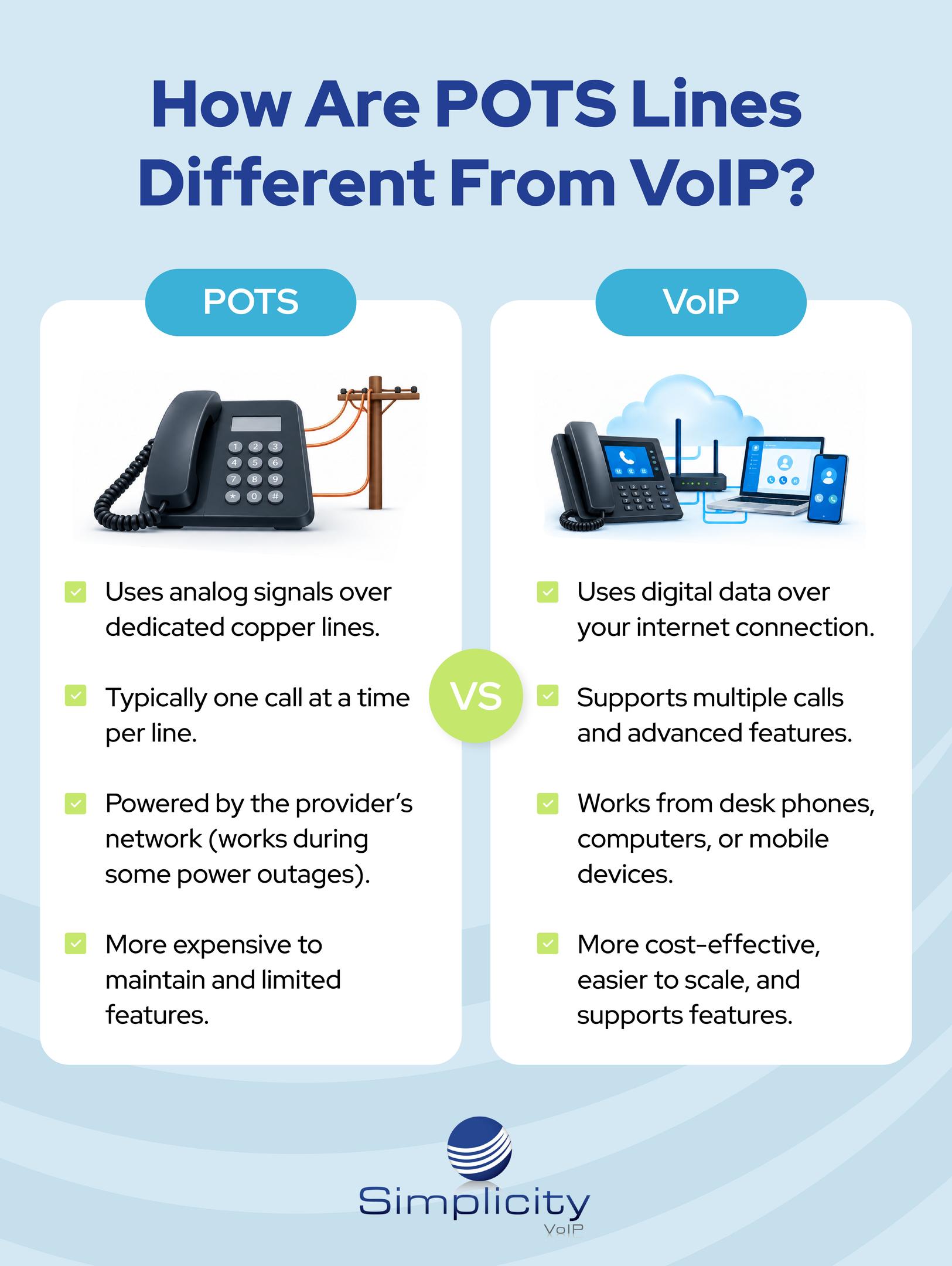
POTS and VoIP both provide voice service, but they carry calls differently.
With POTS, analog signals travel over dedicated copper networks. With VoIP, voice becomes digital data and travels using Internet Protocol technology.
Modern phone services can also support capabilities that analog phone systems typically didn't, including call routing, mobile apps, messaging, video, customer relationship management integrations, and unified communications. Users can work from VoIP phones, desk phones, computers, or even mobile phones.
A VoIP deployment relies on network connectivity, so businesses should plan for bandwidth, redundancy, and a stable internet connection.
For companies comparing business communication solutions, employee calling and specialized analog equipment might require different approaches. But POTS lines are more expensive to maintain than VoIP systems and are easier to scale compared to POTS lines.
How Can You Tell Whether Your Business Still Uses POTS Lines?
Start with your records. Review bills from telecom providers for individual numbers, older analog lines, or charges that are difficult to identify.
Then trace each active line to what it supports. Look past the phone system and check elevator equipment, alarm panels, entry systems, fax stations, mechanical rooms, and other places where equipment might've been installed years ago.
For each line, document:
- The number and location
- The connected device
- Who maintains it
- Whether it supports critical systems
- Any power, monitoring, or compliance requirements
- Whether the device still needs the line
This gives you a usable map of the environment and can uncover services that no longer support active equipment.
Does POTS Line Replacement Require Replacing Every Analog Device?
The FCC allows providers to stop maintaining copper networks, so the aging infrastructure of POTS lines is being phased out in favor of digital systems like VoIP and fiber-optics.
But still, no. POTS line replacement doesn't automatically mean every analog device has to go.
Some POTS line replacement solutions let supported analog equipment continue operating while changing the network service behind it. Depending on the device and service, an analog telephone adapter might be part of the design. Other POTS line replacement options can use IP connectivity, mobile networks, or purpose-built replacement equipment.
The right choice depends on the device. A fax machine doesn't necessarily have the same requirements as an elevator phone, fire alarm, or emergency system. Equipment tied to safety or monitoring should be reviewed according to its requirements.
This is why POTS replacement starts with understanding the equipment rather than just assuming everything connected to copper must be discarded.
Where Do SIP Trunking and Other Modern Alternatives Fit?
There isn't only one single replacement path for every legacy connection.
For a business phone system, SIP trunking can allow an organization to keep compatible on-premises equipment while moving voice service to an IP-based connection. Other businesses can move users to cloud-based VoIP systems and retire an older traditional analog phone system. Specialized equipment can need a dedicated replacement service instead.
The important part is to match modern alternatives to each connection. Modernizing aging infrastructure doesn't always require replacing existing equipment; sometimes it just means changing the service underneath it.
What Should Businesses Know About E911?
E911, or Enhanced 911, helps provide emergency responders with location information associated with an emergency call.
When a business changes its phone system or voice service, E911 planning should be part of the project. Locations, numbers, calling configurations, and emergency procedures should be reviewed during the migration.
The same careful approach applies to critical systems on analog service. Before changing a line, confirm how the replacement will handle connectivity, monitoring, and power requirements.
Why Are Businesses Reviewing POTS Replacement?
As telephone service providers invest in newer network technologies, many businesses are reviewing aging infrastructure and older copper connections.
This doesn't need to become a rushed rip-and-replace project. A planned review gives you time to compare POTS line replacement options, coordinate with equipment vendors, review service contracts, and choose a cost-effective path for each connection.
Start with What Your Lines Support
If you came here asking, "What is a POTS line, the next question is simple: what is yours connected to?
Your organization may have already modernized its main business communications while a few analog connections continue supporting equipment elsewhere. Finding those lines gives you the information needed to decide what stays, what changes, and which modern solutions make sense.
Simplicity VoIP can help identify existing POTS lines, determine what they support, and recommend an appropriate migration path without assuming every analog device needs to be replaced.