
When a patient calls a medical office, they probably want to confirm an appointment, ask about business hours, update insurance information, or leave a message about a prescription refill. But the front desk might already be helping someone in person or answering another call.
That's where AI call handling for healthcare helps.
Used correctly, AI can support administrative workflows by answering routine calls, gathering information, documenting patient intent, and helping callers reach the right person. That means less time manually asking, typing, and transferring routine information, plus a more complete record when staff take over.
An AI medical receptionist should never make clinical decisions. Employees and licensed clinical staff remain responsible for medical advice, diagnosis, urgency, and conversations requiring clinical or human judgment.
What Is AI Call Handling for Healthcare?
AI call handling for healthcare uses conversational AI to manage selected parts of incoming calls for medical practices, clinics, and larger healthcare organizations.
An AI receptionist can use natural language processing and natural language understanding to identify patient intent from a caller's own words, then follow scheduling rules, provider rules, call routing instructions, and escalation procedures.
A healthcare AI receptionist is most useful for predictable administrative work, not every patient interaction.
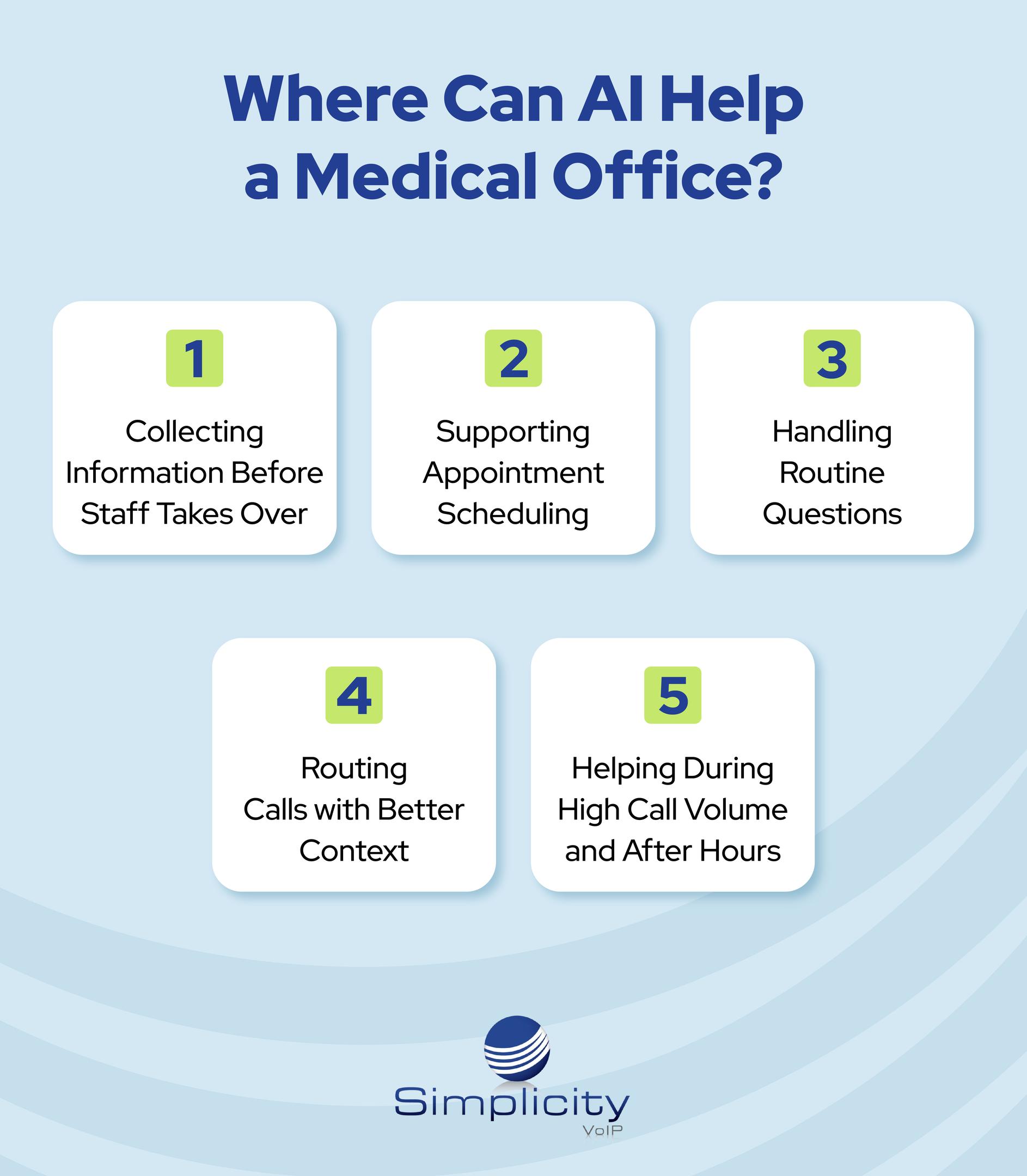
Where Can AI Help a Medical Office?
Collecting Information Before Staff Takes Over
One of the most beneficial uses for AI patient intake is gathering basic information before a staff member enters the conversation.
A virtual medical receptionist can collect a caller's name, date of birth, callback number, reason for calling, preferred appointment time, or other approved details. Those responses can be transcribed into structured data when the integration supports it.
Depending on the available integrations, that information may be used to support patient records or transferred into connected EHR systems within a properly configured HIPAA-compliant environment. This can create a more seamless data flow between the phone system and existing systems.
Front desk teams don't have to start every call from zero. Desk staff can see why a patient called before taking over, reducing repetitive back-and-forth calls.
Supporting Appointment Scheduling
Appointment scheduling can take up a large share of front desk operations, especially as call volumes rise.
An AI receptionist for a medical office can help with scheduling calls by asking what type of appointment the patient needs, checking provider availability when the right integration exists, and following approved scheduling rules.
A healthcare AI receptionist that handles appointment scheduling can schedule or reschedule routine visits, confirm details, or collect information for a staff member to follow up. It shouldn't decide what type of clinical care a patient needs.
Clear provider rules keep automation focused on coordination, which can improve scheduling accuracy and reduce administrative burden.
Handling Routine Questions
Many patient calls are routine inquiries about business hours, directions, office policies, pre-visit instructions, or what to bring to an appointment.
An AI front desk can provide approved answers without pulling a medical receptionist away from someone at the desk. If the platform also supports web chat, the same information may be available through another channel.
For healthcare practices serving diverse patient populations, language capabilities can improve access when configured and tested correctly. Human support should always remain easy to reach for complex questions.
Routing Calls with Better Context
A medical office phone system should help patients reach the right person without repeated transfers.
AI agents can identify why someone is calling and route inbound calls according to established workflows. Billing questions can go to billing, while general messages can be documented for follow-up.
Prescription refill requests can be collected and routed according to the practice's process, but AI shouldn't approve medications or alter clinical workflows.
Likewise, AI assistants can collect information for insurance verification, but verification still depends on payer systems, staff review, and connected tools.
Helping During High Call Volume and After Hours
Staffing shortages, Monday mornings, or seasonal illness can create high call volume while employees are helping patients in person.
An AI answering service can answer phones for routine inbound calls simultaneously, improving call answer rates and reducing missed calls. After hours, it can answer common questions, collect messages, or route approved requests.
The system should never present itself as a substitute for emergency services or determine the urgency of symptoms.
Where Should Human Support Take Over?
Automation works best when the boundary between administrative work and clinical decisions is clear. A medical receptionist, nurse, clinician, or other appropriate employee should take over when a conversation involves:
- Symptoms or changes in a patient's condition
- Medical advice or treatment questions
- Emotional or sensitive patient care concerns
- Complex billing or insurance issues
- Complaints or unclear information
- Situations requiring clinical judgment
- Any call that might be urgent
AI can recognize language patterns, but it can't replace human judgment or decide how serious a situation is. Not every call needs a person from the first second, but every caller should have a clear path to one when needed.
What About HIPAA Compliance and Patient Data?
Any healthcare technology that collects, transcribes, stores, or transfers patient information should be evaluated for appropriate privacy and security safeguards and for how it fits within the organization's HIPAA compliance requirements.
Keeping patient data safe requires more than choosing software marketed for healthcare. HIPAA compliance depends on how technology is configured, what information it handles, where that information goes, who can access it, and what vendors are involved.
For AI call handling, healthcare organizations should review data storage, access controls, retention policies, integrations, vendor agreements, and the path information takes between multiple systems. Not all AI receptionists are HIPAA compliant out of the box.
If call information moves into patient records, EHR systems, scheduling platforms, or another health system application, the organization should understand that data flow before launch. Supporting desk operations without shortcuts around privacy and security requirements is what makes a successful solution. Compliance must be built into the architecture, not an afterthought.
What Does AI Call Handling Look Like in Practice?
Imagine three patients call a clinic at about the same time.
The first wants to move a routine appointment. The AI receptionist gathers the needed details and, if the integration supports it, offers available times based on scheduling rules.
The second has a billing question. The system collects basic information and routes the call with context attached.
The third begins describing symptoms. That call should leave the routine administrative workflow. AI should not diagnose the problem, decide its severity, or provide treatment advice. It should follow the organization's predefined escalation process and involve appropriate human staff.
This is where an AI medical receptionist adds value. It handles predictable work without pretending every healthcare conversation should be automated.
How Should Healthcare Practices Introduce AI?
Start with repetitive tasks that create the most friction for front desk teams. Map why patients call, which routine calls follow a consistent process, how information moves through existing systems, and which calls must reach a person.
Large health systems may need broader integrations and governance. Smaller medical practices can start with one or two use cases, like answering calls after hours or collecting basic patient intake details.
The technology should fit established desk operations, not force staff to rebuild them around AI.
Can AI Replace a Medical Receptionist?
No, and that shouldn't be the goal either.
An AI receptionist can act like a desk assistant for selected administrative tasks. It can support answering calls, collecting information, routing routine requests, and coordinating appointments.
A human medical receptionist brings context, empathy, flexibility, and judgment that AI doesn't have. The AI front desk handles repetitive administrative work. People handle sensitive conversations, clinical concerns, and patient care, improving the patient experience while reducing repetitive phone calls.
AI Should Make the Front Desk More Effective, Not Less Human

When AI call handling for healthcare is designed well, it can reduce administrative burden, improve patient intake, organize patient communication, and help staff enter conversations with better information.
That can mean fewer missed calls, less manual typing, better routing, and fewer interruptions for employees balancing patient care with administrative responsibilities. It also helps reduce lost revenue tied to unanswered scheduling opportunities or poor follow-up.
A healthcare AI receptionist can collect information, support scheduling, answer routine questions, and route calls. By reducing hold times and providing faster responses to routine requests, it can help create a more responsive patient experience.
Simplicity VoIP helps organizations explore AI call handling and communication tools that support staff without removing people from the moments that need them most.
Reach out today for AI communications help in your facility.