
If you’ve already explored what a SIP trunk provider does, the next step is understanding how SIP trunking actually works in a real business environment.
SIP trunking is more than a replacement for traditional phone lines, it’s a shift in how business communications are delivered. Instead of relying on physical phone lines and legacy infrastructure, SIP trunking uses a virtual connection over your internet connection to transmit voice data.
This guide explains what SIP trunking is, how SIP trunking works, and why it is quickly becoming the standard for modern phone systems.
What Is SIP Trunking?
At a basic level, SIP trunking is a method of sending voice calls over the internet instead of through the public switched telephone network (PSTN) or other traditional phone systems.
SIP stands for Session Initiation Protocol, sometimes written as session initiation protocol SIP, which is the protocol used to establish and manage communication sessions. These communication sessions can include voice calls, video conferencing, and other real time communications.
A SIP trunk acts as a virtual version of traditional phone lines. Instead of a physical connection, a SIP trunk uses internet protocol to transmit voice traffic as data packets over a data connection.
This means your business phone system can connect calls through the telephone network without relying on analog phone lines or PRI circuits.
How SIP Trunking Works in Plain English
Understanding how SIP trunking works doesn’t require a technical background.
Here’s what happens when you make a call using a SIP trunking system:
- A user places a call from a desk phone setup, VoIP phone, or mobile device
- The phone system converts the voice into digital voice data
- That voice data is broken into data packets and sent over your internet connection
- A SIP provider routes the SIP traffic through the public switched telephone network or to another endpoint
- The recipient can receive phone calls like any standard call
This is how SIP trunking work in practice, it replaces physical lines with SIP connections that allow multiple calls to happen at once.
Instead of being limited by hardware, your SIP channel capacity determines how many concurrent calls your business can handle.
SIP vs PRI: Why Businesses Are Moving On
When comparing SIP vs PRI, the difference is largely about flexibility and efficiency.
PRI (primary rate interface) relies on fixed physical line. Adding PRI capacity means scheduling an installation, waiting on your provider, and paying for channels you may not always need. It also relies on a limited number of channels. A T1 PRI gives you exactly 23 voice channels; that's a hard ceiling. If your call volume increases, you need to install more infrastructure.
SIP trunking removes that limitation because SIP trunks scale in single-channel increments, and you only pay for what you use. So, a spike in call volume doesn't require a technician or a new circuit.
With SIP trunking, you can:
- Scale up or down based on call volume
- Support multiple calls without adding new phone lines
- Connect multiple locations through one communications system
Unlike traditional phone systems, SIP trunking allows your phone system to operate over a shared internet connection, eliminating the need for additional physical phone lines.
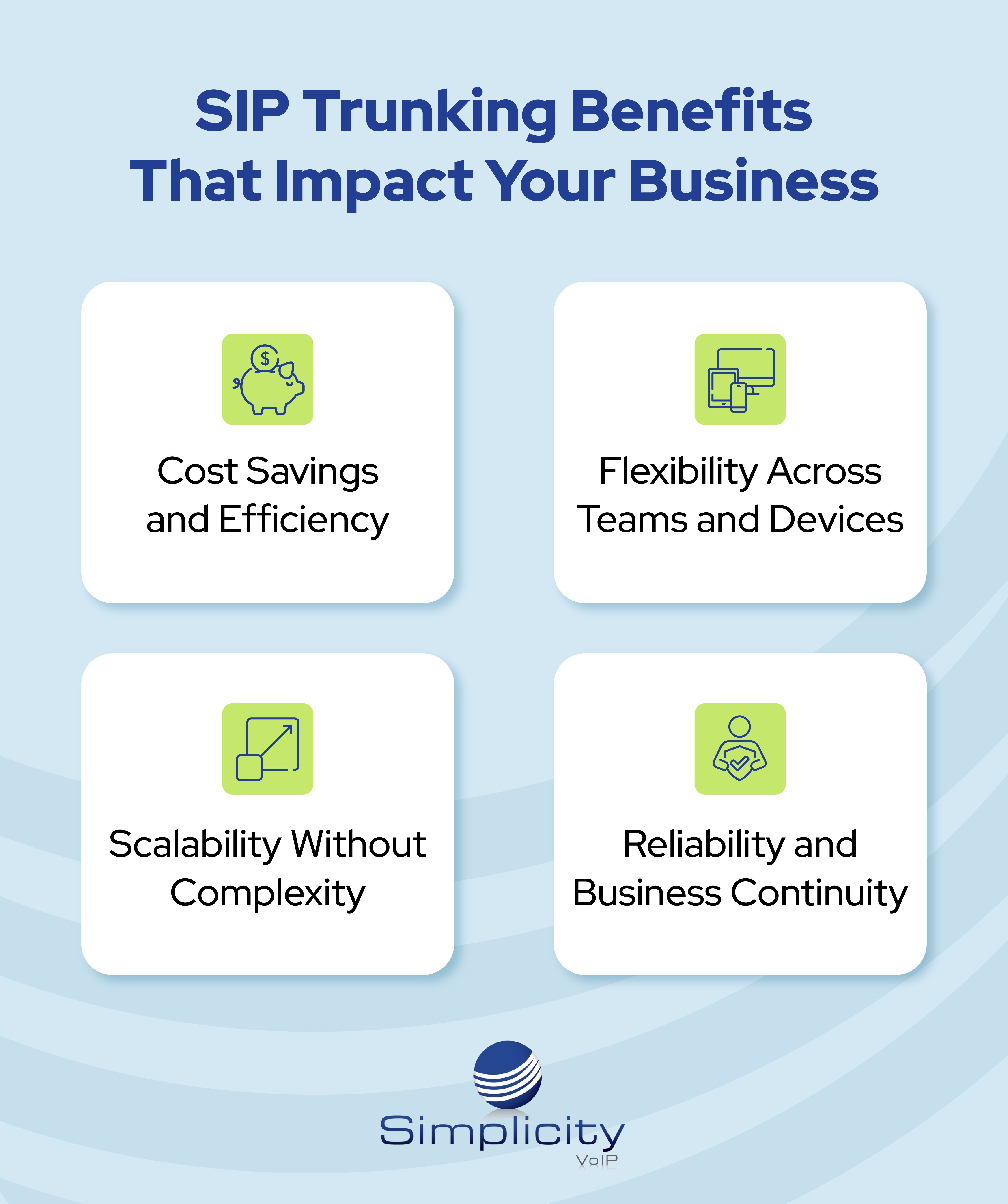
SIP Trunking Benefits That Impact Your Business
The benefits of SIP trunking become clear when you look at real business outcomes.
Cost Savings and Efficiency
SIP trunking offers cost savings by eliminating unused phone lines and reducing the need for maintaining legacy infrastructure.
International calls are typically more affordable, and your service plan can be adjusted as your business grows.
Flexibility Across Teams and Devices
Your phone system is no longer tied to one office or one device.
Employees can connect calls from multiple devices, including mobile devices and VoIP systems, while still using existing phone numbers.
Scalability Without Complexity
Need to increase concurrent calls? Add a SIP channel.
No need for new hardware or physical lines, just adjust your SIP trunking service.
Reliability and Business Continuity
Modern SIP trunking providers use redundant infrastructure and failover routing to maintain call quality and uptime.
If there’s an issue, calls can be rerouted instantly to support business continuity and disaster recovery.
Real-World Use Cases for SIP Trunking
Seeing SIP trunking in action helps make it more tangible.
Multi-Location Businesses
Companies with multiple locations can unify their communications system under one SIP trunking system.
This reduces costs and simplifies management across locations.
Remote and Hybrid Teams
Employees working remotely can still access the same phone system using VoIP call capabilities and unified communications tools.
This ensures consistent business communications no matter where your team is located.
Growing Small Businesses
For small businesses, SIP trunking provides a scalable alternative to traditional phone systems without requiring large upfront investments.
High Call Volume Environments
Businesses that handle multiple communication channels can manage incoming calls and outgoing traffic more efficiently using SIP trunking.
What Happens Behind the Scenes
While SIP trunking feels simple to use, there’s advanced trunking technology working in the background.
Call Routing and Connectivity
A SIP provider ensures calls are directed correctly across the switched telephone network and internet telephony service provider networks.
Integration with Existing Systems
SIP trunking can connect to your existing phone system, current PBX (private branch exchange) system, or IP PBX without requiring a full replacement.
Unified Communications and Collaboration
SIP trunking supports unified communications by integrating voice, video conferencing, and collaboration tools into one platform.
Security and Performance
Modern SIP trunking providers include security features to protect voice traffic and maintain call quality across all SIP connections.
Why SIP Trunking Is Becoming the Standard
SIP trunking is gaining traction because it aligns with how businesses operate today. Whether you're supporting remote employees, managing multiple office locations, handling seasonal call spikes, or planning for growth, traditional phone systems can be difficult and expensive to scale.
SIP trunking offers a more flexible approach by allowing businesses to add capacity, support distributed teams, and adapt their communications system without major infrastructure changes.
It also provides greater visibility into communication performance. Features like call analytics, reporting, real-time monitoring, and intelligent call routing help businesses understand call patterns, identify issues, and improve customer experiences.
A lot of SIP trunking solutions also include failover capabilities that automatically reroute calls during an outage, helping maintain business continuity.
For SMBs, growing organizations, and enterprises, these capabilities can translate into lower costs, simplified management, and a more reliable phone system.
Modern SIP trunking providers continue to expand their offerings with enhanced redundancy, stronger security features, deeper integrations with unified communications platforms, and support for emerging technologies that help businesses stay connected and productive.
As communication needs continue to evolve, SIP trunking gives organizations a scalable foundation that can grow alongside their business.
Transitioning to SIP Trunking Without Disruption
Moving to SIP trunking doesn’t mean replacing everything at once.
Most businesses can integrate SIP trunking with their existing phone system and migrate gradually.
A new SIP provider can help you transition while keeping your existing phone numbers and minimizing downtime.

Where Simplicity VoIP Fits In
Choosing the right service provider matters.
Simplicity VoIP focuses on delivering SIP trunking services that are easy to implement and manage.
From managing SIP channels to ensuring call quality and supporting multiple communication channels, the goal is to simplify your business communications.
SIP Trunking Is Not Just a Technology Upgrade
It's a better way to manage your phone system.
By replacing traditional phone lines with a flexible, internet-based approach, SIP trunking allows businesses to handle voice calls, scale efficiently, and support modern communication needs.
Once you understand how SIP trunking works, it becomes clear why so many organizations are making the switch.
If you're ready to be one of those businesses, reach out, and we'll help you get started!